Architecture August 30, 2010 By Virginia Smith

filler139 Villa Nyberg

Photography by Kjellgren Kaminsky

Photography by Kjellgren Kaminsky

filler139 Villa Nybergnyberg title Villa Nyberg
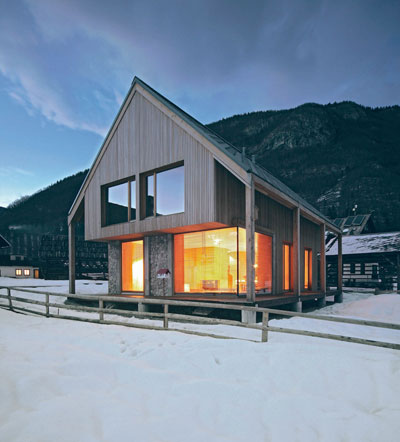
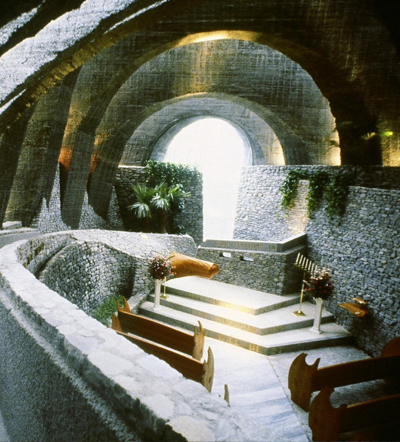
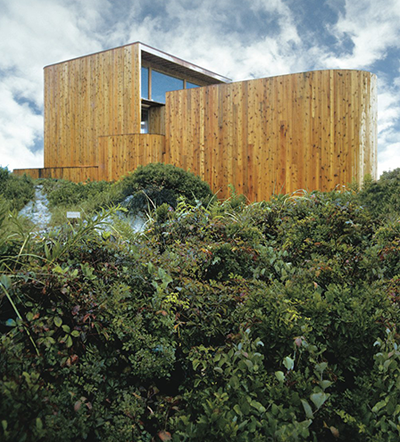
With the recently opened Treehotel and now Villa Nyberg, Sweden seems to be making a case for itself as the world’s hub of cutting-edge green architecture. In collaboration with Emrahus and commissioned by the Nyberg family, all-star architecture firm Kjellgren Kaminsky has just unveiled Villa Nyberg, setting a new standard for the concept of the “passive” house.
     Still a budding art form in the world of green architecture, passive houses are designed to draw on the energy — and there’s always quite a bit of it — created by the house’s residents and their appliances, thus wasting as little energy as possible for basics like heating. The houses are extremely well insulated, and tests have recently found that the Villa Nyberg will only consume kWh/m2 per year for heating and has set a new airtightness record for Sweden.
     Views from the Villa of the adjacent lake in Borlänge, Sweden are an instant reminder that Kjellgren Kaminsky has given as much attention to form as to function with this house, which has been given its circular shape for purposes of airflow efficiency. As one of the world’s leading firms for passive houses, Kjellgren Kaminsky is now aiming to make eco-friendly architecture, normally the territory of elite home buyers, a more accessible option, meaning we may live to see the day when the word “passive” can be applied to the world of New York real estate.

1 2 3 4


Architecture August 24, 2010 By Nalina Moses

filler140 Citizen Architect

Citizen Architect film still courtesy of PBS and Rural Studio

Citizen Architect film still courtesy of PBS and Rural Studio

filler140 Citizen Architectcitizenarchitect title Citizen Architect
The image we have of the modern American architect is of a charismatic conjurer like Frank Lloyd Wright, wandering about with his cape and cane, or a narcissistic obsessive like Howard Rourke in The Fountainhead, deeply immersed in the details of his work. So the late Samuel Mockbee, the well-regarded architect and professor at Auburn University, cut a welcome figure. Stout, bearded, wily, and garrulous, he seemed more like Santa Claus than an architect.
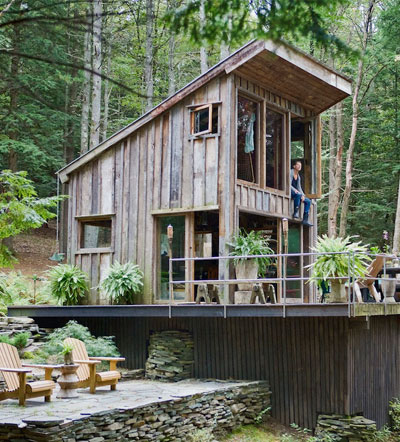
     That comparison might not be so ridiculous. Mockbee’s greatest accomplishment was to establish the university’s Rural Studio, a program that instructs students by leading them to design and then literally construct buildings for the needy in Hale County, Alabama. Sam Mainwright Douglas’ new documentary, Citizen Architect: Samuel Mockbee and the Spirit of the Rural Studio, which premieres nationwide on PBS Monday, August 23 and will be released for rental afterward, is an excellent introduction to the Studio and its work.
     Since its inception in 1993, the Rural Studio has completed several small houses and public buildings each year. In Citizen Architect we see a class of sophomores working together to build a house for a local man who had been living in a rusting trailer. We also see some of the handsome buildings that the Studio has already completed, including an animal shelter, a fire station, and a church. And we hear interviews with architects throughout the country who are carrying on Mockbee’s vision by practicing “social architecture,” doing work that’s pragmatic and community-centered.

1 2 3 4 5 6 7 8 9

 
BLOGS
Art Observed
Artco
Eclectic Cow
Fashionista
Kempt
Magculture
 
PUBLICATIONS
Another Magazine
Good Magazine
Lost at E Minor
Refinery 29
Rhizome
S Magazine
Superfuture
MISCELLANEOUS
Charity: Water
Radio Nova
Tiny Vices


Architecture, Books August 11, 2010 By Nalina Moses

filler134 Julius Shulman

All photographs are by Julius Schulman and Juergen Nogai, copyright 2010 (Click images to enlarge)

All photographs are by Julius Shulman and Juergen Nogai, copyright 2010

filler134 Julius Shulman

SHULMANTITLE Julius Shulman

Architectural photographer Julius Shulman documented so many truly great buildings — canonical works by Richard Neutra, Rudolf Schindler, and Charles and Rae Eames — that it’s easy to take his skills for granted. We see the technical assurance in his pictures but credit much of their beauty to the architecture itself. A new book, Julius Shulman: Chicago Mid-Century Modernism, which documents houses by lesser known architects, puts that notion to rest. These more modest houses are burnished by Schulman’s lens so that they too emerge as masterpieces.
     This entire generation of Chicago architects was working under the immense shadows of Frank Lloyd Wright and Mies van der Rohe, modern masters who had built in and around the city. They all adapted common building technologies, like brick walls and wood framing, to achieve the deep cantilevers, full-height windows, and open plans of a modernist vocabulary. And they all adapted the long, low, interlocking volumes of Wright’s prairie style to suit simpler, smaller houses.
     The houses documented in the book are warmer and more welcoming than the Case Study Houses that Shulman shot in the 1950s, whose pristine geometries exuded high style. For one thing the Chicago houses were photographed decades after their completion, after they’d been lived in and roughed up a bit. And the houses possess a richer, darker palette. They’re finished with oak panels, rough stone facing, and colored ceramic tiles, and filled with shaggy rugs and hand-thrown pottery.

1 2 3 4 5 6 7 8 9 10

Architecture, Books July 23, 2010 By Nalina Moses

Azkoitia Municipal Library, Gipuzcoa, Spain, 2007.  Estudio Beldarrain.  Facade built from railroad ties. All images courtesy of W.W. Norton. (Click images to enlarge)

Azkoitia Municipal Library, Gipuzcoa, Spain, 2007. Estudio Beldarrain.
Facade built from railroad ties.
All images courtesy of W.W. Norton. (Click images to enlarge)

rematerial title Rematerial
Short of building nothing new at all, the most environmentally-conscious strategy toward construction is to build with what materials are at hand. This reduces the extent of mining and foresting, the energy required for fabrication, and the emissions associated with shipping.
     One powerful and increasingly popular approach is to build with waste materials. This can be implemented at different scales, by powdering demolished concrete blocks to use in a new mix, building a house on an old foundation, or reinvigorating an abandoned site like Governor’s Island. Alejandro Bahamon and Maria Camila Sanjines have compiled some of the more promising waste-capturing projects in an inspiring new book, Rematerial: From Waste to Architecture.
     The projects have a distinct aesthetic, one that values the patina of weathered and marred materials over refined geometries and gleaming surfaces.  A small library in Spain, whose walls are constructed from stacked railroad ties, has a rough, mottled appearance. A house addition in The Hague, with a facade of tread-worn tires, has a post-apocalyptic, Mad Max look.

1 2 3 4 5 6 7 8 9


filler116 Architecture of the Sun

Images courtesy of Rizzoli USA (Click images to enlarge)

©Thomas S. Hines, Architecture of the Sun, Rizzoli, 2010. All images courtesy of Rizzoli. (Click images to enlarge)

architecturesun title Architecture of the SunCalifornia modernism, which gave rise to stunning works by Rudolf Schindler, Richard Neutra, and Charles and Rae Eames, is often overshadowed by its better-celebrated East Coast and European counterparts. So Thomas S. Hines’ new compendium of modern buildings in Los Angeles, Architecture of the Sun, is a welcome corrective.
     Hines is a well-known architectural historian who tracks design developments thoughtfully, but his real achievement here is the astounding collection of photographs and drawings he’s assembled. Unlike in other cities, in Los Angeles many influential modern structures were small houses and stores that were particularly vulnerable to the vagaries of the market, and also fires and earthquakes. The book brings some of those long-gone buildings back to life, and brings works by less celebrated architects such as Irving Gill and Raphael Soriano to the forefront.
     In many ways Los Angeles was the perfect ground for modern building. Its open, undeveloped landscape, temperate weather, and dry climate lent itself to a spacious, inside-outside architecture that was less concerned with planning and weatherproofing than with sculptural expression.

1 2 3 4 5 6 7 8 9

filler97 Red Hook Green

Photography courtesy of Garrison Architects.

Photography courtesy of Garrison Architects. (Click images to enlarge)

filler97 Red Hook Greenredhookgreen title Red Hook GreenWhile “sustainability” is possibly the hottest buzzword in the world of contemporary design, the term “net zero-energy” is comparatively unknown. Red Hook Green, the newest project by the Brooklyn-based Garrison Architects, is likely to change that. The project is poised to be New York’s first net zero-energy live/work building — it will sustain itself through natural means, and contribute no pollution to our beleagured city air.
     The US Department of Energy defines a zero-energy building, or ZEB, as “a residential or commercial building with greatly reduced energy needs through efficiency gains such that the balance of energy needs can be supplied with renewable technologies”. What’s most revolutionary about the concept of a ZEB is that it asserts that city structures can meet all their energy needs from such low-cost, locally available, and renewable resources as solar and wind power.
     Red Hook Green is approximately 4,000 square feet and includes space for a studio/workshop, corporate offices, garages and a residential apartment — as well as an outdoor green space. Inspired by shipping containers (whose creative potential we covered earlier), the building’s form pays homage to the its Red Hook location, which has long been defined by its active shipping port. Composed of stacked, modular units, the design also takes advantage of the area’s incomparable harbor views. Here’s hoping that this initial effort allows the most greenest of design concepts to take root in the most urban of settings.
     Red Hook Green is to be completed by December 2010. Until that time, those interested can follow its progress through its blog.

1 2 3

filler86 Flying Sauna

Photography courtesy of H3T Architects (Click images to enlarge)

Photography courtesy of H3T Architects (Click images to enlarge)

filler86 Flying Saunaflyingsauna title Flying SaunaSuspended above the river Elbe, a simple wooden cube hangs from an abandoned bridge. The structure, executed by H3T architects, was crafted hastily from cheap and recycled materials, but this cube is not intended to remain intact for more than a couple of weeks. While it stands, visitors are encouraged to gather firewood from the surrounding wilderness, hoist themselves through a trap door accessible only by boat, and enjoy the pleasures of an aerial sauna.
     Called the Flying Sauna, H3T warns potential visitors to proceed with caution when attempting to use it, noting that the underlying river’s current is strong. Indeed, the bridge that it hangs from marks the site of a weir that was dismantled during the mid-1970s. The sauna is meant to serve as a way of calling attention to the abandoned structure.
     The Flying Sauna is the Czech studio’s second public sauna project. In 2009, H3T erected Sauna on the Water, a four-day construction project that produced a floating steel and plywood cube with a cast iron stove installed for heat. H3T advises using the saunas by moonlight in order to emphasize the contrast between the “beautiful lantern light” and the glistening lake. Both projects are a certainly a far cry from the glossy, tiled saunas that accompany many modern gyms and swimming pools. Instead, the humble cubes are reminiscent of traditional saunas that interact with their natural settings, whether they were burrowed into an earthen pit or built entirely from stone and wood. By reclaiming the origins of the sauna, H3T has managed to celebrate the natural and the manmade simultaneously.

1 2 3 4 5


Photography by Dan Farrar. Additional photography by Groves-Raines Architects. (Click images to enlarge)

Photography by Dan Farrar. Additional photography by Groves-Raines Architects. (Click images to enlarge)

compost title Composting Shed at Inverleith TerraceOne mile north of Edinburgh’s city center, a composting shed has garnered a great deal of international attention. Boasting two Scottish Design Awards and an Excellence in Design Award from the American Institute of Architects, the seven-month construction project was conceived and executed by Scotland’s Groves-Raines Architects. Made from Corten steel and rebar — the steel used in reinforced concrete — the shed has the potential to strike a jarring contrast with the surrounding greenery. Yet the industrial materials are manipulated with traditional techniques, creating a structure that emerges strikingly naturally from its surroundings.
     Because the rods that make up the shed are inserted directly into the ground, the garden remains unaffected by any invasive building foundations. To create the dual-purpose composting shed and garden store, the architects relied on “a technique similar to traditional willow weaving” to make the steely walls more conducive to its earthy setting. Bent into smooth curves, the rods lose much of the harsh quality often associated with industrial building materials and begin to blend seamlessly with the adjacent wooded area. The woven rods allow air and light to stream into the shed, a benefit both practical and aesthetic. Lastly, the roof is made with weather-resistant EPDM lined steel and planted with grass, reinforcing “the connection with the wooded context” that the architects rightfully claim. By re-purposing the typical building blocks of urban architecture to create an “organic form” structure, Groves-Raines Architects successfully reimagines our uses for man-made materials.

1 2 3 4 5 6 7

Photography courtesy of Imaging Atelier.

Photography courtesy of Imaging Atelier. (Click images to enlarge)

arcticcircle title Arctic Circle AirportWhen an Oslo-based architectural firm committed to “boldness” and “innovation” joins creative forces with the “international outlook” of a young London firm, it seems likely that their collaborative efforts will favor universal appeal over landscape-specific subtlety. Judging by the concept sketches and feasibility report presented by Narud Stokke Wiig Architects and Planners and Haptic, however, the firm’s proposed design for a Norwegian international airport located just below the Arctic Circle manages to fit both criteria.
     Avoiding the harsh juxtaposition of a thoroughly modern structure against the backdrop of an otherwise remote and forested region, NSW and Haptic have instead molded their sharp lines to mimic the local terrain. Shoving the terminal building’s roof into a series of jagged peaks, the design pays homage to the nearby mountains of Traena, with a control tower enclosed within the structure’s tallest peak.
     The Nordland, Norway airport certainly isn’t the first of its kind to take inspiration from the surrounding landscape. Yet similar structures like the Denver International Airport, known for its peaked white tensile fiberglass roof reminiscent of the Rocky Mountains, supplement their visual tribute to the environment with sustainable design and environmentally sound materials. Since 2008, DIA has vastly reduced its annual carbon emissions with a massive on-site solar energy system.

1 2 3 4 5

(un)plug, design for an office tower in Paris

(un)plug, design for an office tower in Paris

biore title BIOREBOOT

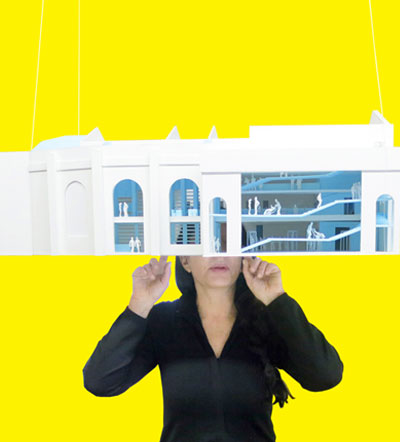
Green thinking is changing the way we build. We’re reusing existing structures and materials, designing more efficient building systems, and thinking about long-term sustainability. But these changes are minor in view of the far deeper changes to come, as ecologically-minded designers reexamine their most fundamental assumptions about a door and a roof and a foundation, and reimagine what a building is entirely.
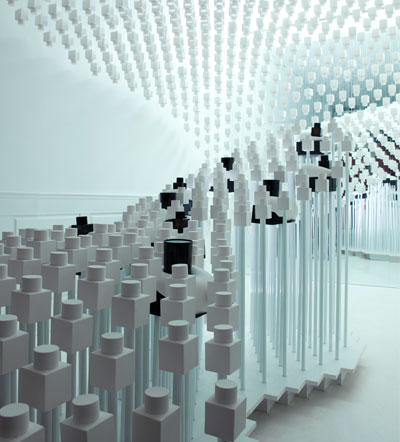
     The visionary French architecture office R&Sie(n) is right at the forefront. Its projects, collected in the book Bioreboot: The Architecture of R&Sie(n), offer an architecture that’s deeply enmeshed with natural forces, and entirely liberated from modern conventions about design and construction.
     Since the mid-nineteenth century, when steel framing supplanted heavy masonry construction, buildings have been conceived as stable shells that shaped efficient interior environments, as machines for living. R&Sie(n) complicates this paradigm. Its buildings aren’t discrete, unchanging objects but mutable devices embedded within ecologies of weather, time, geology, flora, and fauna.

1 2 3 4 5 6 7