
Art, Fashion September 2, 2010 By Alaina Claire Feldman

Photography courtesy of Istanbul Museum of Modern Art (Click images to enlarge)

Photography courtesy of Istanbul Museum of Modern Art (Click images to enlarge)

hussein title Hussein Chalayan
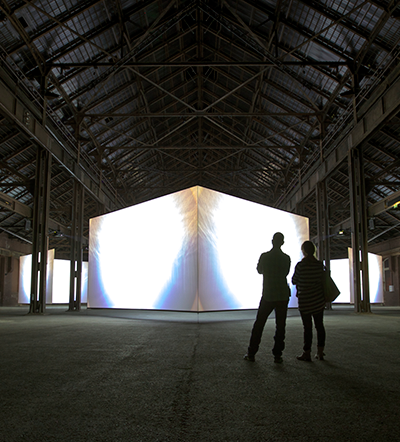
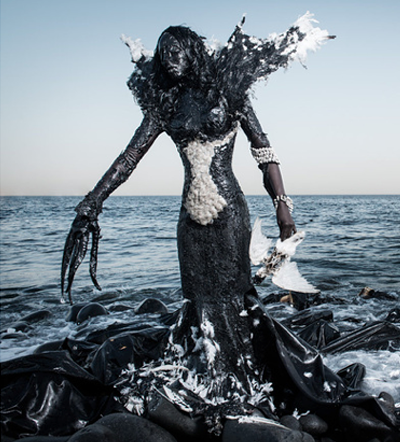
Nomadism. Technology. Migration. Utopia. Body Politics. The myriad themes considered in the work of Hussein Chalayan are unlike that of any other contemporary fashion designer. Hussein Chalayan uses fashion as a medium for presenting and discussing the semiotics of clothing. Chalayan interrogates standard cultural signs and materials by demystifying the common values related to fashion such as superficiality and frivolousness.
     After graduating from the Türk Maarif College, Chalayan continued his studies at London’s Saint Martin’s School of Art. For his senior thesis project in 1993, his Tangent Flows collection featured silk dresses that had been covered in iron filings, buried in the ground for months and then unearthed just before the show and presented with a text that explained the process. The garment’s rituals of burial and resurrection referred to life, death, and urban decay in material objects. This collection not only launched his career (his label was created only a year later in 1994), but helped him achieve global success as someone working between the complex mix of contemporary artist and fashion designer. Chalayan has twice been named British Designer of the Year and has received numerous awards and honors since Tangent Flows.

1 2 3 4 5


Art August 30, 2010 By Jennifer Pappas

Justin Giarla with one of Skinner's masks

Justin Giarla with one of Skinner's masks

justingiarla title Justin Giarla Interview
If San Francisco is the renegade city of the art world, Justin Giarla is most definitely captain of the ship. Since first opening the Shooting Gallery in 2003 (in a neighborhood that gently put, is a little shady), he’s become the shining beacon of a city excluded from both the nexus of New York City and the star-studded vault of Los Angeles, a city no longer taken seriously when it comes to fine art. Specializing in urban contemporary and pop surrealism, Giarla’s spreads his expertise between four different art spaces including Gallery Three and the Shooting Gallery’s influential sister gallery, White Walls. Known in local circles as equal parts philanthropist and curator, Giarla’s work outside the galleries speaks at even higher volumes about his commitment to community engagement through the conduit of art. He hosts annual fundraisers for local nonprofits and is closely involved with Hospitality House, an organization that offers facilities and art resources to the homeless free of charge, no questions asked.
     Giarla’s newest progeny, 941 Geary will host its inaugural show on September 18 with a circus-inspired “art opera of epic proportions” including real life carnies and interactive games courtesy of Mike Shine. PLANET picks the brain of the man who is single-handedly attempting to reinvigorate the San Francisco art culture by example and sheer force of will.

1 2 3 4 5 6 7 8

 
BLOGS
Art Observed
Artco
Eclectic Cow
Fashionista
Kempt
Magculture
 
PUBLICATIONS
Another Magazine
Good Magazine
Lost at E Minor
Refinery 29
Rhizome
S Magazine
Superfuture
MISCELLANEOUS
Charity: Water
Radio Nova
Tiny Vices


Art August 27, 2010 By Nika Knight

estelle title Estelle Hanania
Estelle Hanania’s images explore otherworldly spaces, the sharp realness of her photographs a startling contrast to the ethereality of their subjects — burning hands, glittery crystals, spookily-real human scarecrows, and men dressed as eery, totem-like birds. Exploring the allure of ritual, costumes, and folk traditions, Hanania’s photography is a beautiful reminder of a certain eccentricity inherent to all cultural beliefs and behaviors.
     Hanania tells us, “I don’t take pictures on a daily basis, and everyday life is more visually boring to me than inspiring, most of the time. Visually, I like when strange things collide and provoke questions.” Of her photographs of costumed men at carnivals (which she’s been taking since 2006) she ways, “I’m attracted by a feeling of disorientation and excitement that you can find in these gatherings and costumed traditions…. I loved this kind of situation where everything gets confused and uncertain, but you still can define the most familiar shape which is the human figure, vanishing.”

1 2 3 4 5 6 7 8

Art August 17, 2010 By Nika Knight
At Warm Springs, 1991, from the series Immediate Family. All photography courtesy of Sally Mann and Gagosian Gallery. (Click images to enlarge)

At Warm Springs, 1991, from the series Immediate Family. All photography courtesy of Sally Mann and Gagosian Gallery. (Click images to enlarge)

sallymann title Sally Mann
Sally Mann’s photography is simultaneously nostalgic and startlingly real, a beautiful depiction of the contemporary South and the more immediate space of the family. Mann’s preoccupations with growth, time, death, and decay are captured in her images of her young children, the old Civil War battlefields that surround her, and the way in which the people and the wild landscape grow, die, and merge together. Her first solo exhibition in the UK, The Family and the Land: Sally Mann looks at her long career in light of her impulse to focus on the physical world surrounding her as her primary subject.
     The show draws from perhaps her most well-known series, Immediate Family, as well as Faces, Deep South and What Remains. The exhibition first focuses on her portrayal of her young children in all their innocence and immediacy. Faces and What Remains follow with Mann’s unflinching look into the physicality of being, ultimately demonstrating the bare fact of decomposition after death — the literal merging of bodies back into the earth. Finally, the images in Deep South explore the landscape of the South, focusing on the physical and metaphorical Civil War scars that still mark the land. Displayed in a European context, Mann’s photographs take on a more sharply American sheen, their location abroad more directly connecting to them to life within the intricate, complicated space of the rural American South.

The Family and the Land: Sally Mann is on display at The Photographer’s Gallery in London through September 19.

1 2 3 4 5


Art August 16, 2010 By Alaina Claire Feldman

filler136 Sugar Water

Film stills courtesy of Eric Baudelaire

Film stills courtesy of Eric Baudelaire

sugarwater title Sugar Water
In the first half of the 20th century, French philosopher Henri Bergson described duration as an invisible process, like sugar dissolving in a glass of water. Using this reference as a jumping-off point, the Paris-based artist Eric Baudelaire has created the film Sugar Water, which is presented at the Hammer Museum in Los Angeles for the artist’s first U.S. solo museum show.
     The film takes place on the fictional Paris metro platform at the fictional Porte d’Erewhon, where a billposter descends into the station to cover a large advertising billboard painted bright blue. He continues to wheat-paste a sequence of images that depict a common car parked on an anonymous Parisian street. He continues by then covering that image with one of the same car busting into flames. The billposter continues until the car becomes swallowed up in smoke, and then remains only as a burnt-out skeleton of the former car. All the while, metro riders enter and exit the scene seemingly oblivious to the slow-motion narrative action taking place. Baudelaire hired a real billposter to lay down the imagery, but the commuters who move in and out of the station are all hired actors, enacting a sort of role reversal in which the person upon whom the single camera focuses is not an actor; the “extras” who fill the background, meanwhile, are. Eventually, this cinematic event unfolds over the seventy-two-minute film, creating a slow reflection on images we typically experience in our news media.

1 2 3 4 5 6

Art August 12, 2010 By Editors
Art August 10, 2010 By Jennifer Pappas

filler131 Canada Gallery

Photography courtesy of Canada Gallery. (Click images to enlarge)

Photography courtesy of Canada. (Click images to enlarge)

filler131 Canada Gallerycanadatitle Canada Gallery
In the oversaturated sea that is the New York City art scene, Canada on the Lower East Side somehow manages to stand out — way out. Due credit should be given to the gallery’s innate fearlessness and to-hell-with-it attitude but bottom line, Canada has a knack for culling some of the best talent around. To critics’ delight, this summer’s Homunculi brought the alchemical mythologies and freakishly skilled talents of Allison Schulnik, Ruby Neri, Matt Greene, and Matthew Ronay out to play. And just last week the gallery hosted Slummer Nights, a 4-night collaborative spectacular organized by Sadie Laska that took the most magical elements of a variety show, underground music festival, and art opening and threw it all together for one rousing good time. Canada’s resident artists offer more of the same. From Joe Bradley’s rudimentary Superman logos to Devendra Banhart’s imaginative, oscillating creatures and Sarah Braman’s found furniture installations, there’s an underlying sense of innocence, determination, and makeshift playfulness embedded in every artist Canada represents. Not to say that the gallery is all fun and games. There’s plenty of provocative, slightly off-kilter work to go around. Just ask Phil Grauer, one of the four owners/partners behind it all.

1 2 3 4 5 6


Art August 9, 2010 By Nika Knight

Photography by Samantha West. (Click images to enlarge)

Photography by Samantha West. Click image for slideshow.

samanthawest title Samantha West
We recently came across Samantha West’s photography and felt the need to share it. Born and raised in New York City, West is inspired by “the curious combination of vintage nudes, birds, Fred Astaire movies, bus rides, mermaids (and their long mermaid hair), horses, barefoot cooking, and planning trips she can’t afford quite yet.”
     Published across Europe, Asia and North America, she’s been featured in publications ranging from Vanity Fair Germany to The New York Times. Currently shooting lookbooks for several different fashion designers, West is also making time for her personal project, Musings. She writes, “I love to photograph my friends in their most personal spaces — their bedroom and bath, where intimacy and femininity reign. My focus has always been on the face, skin, pores, lips, hands. I love a unique visage. I love intimacy and honesty.” Finally, she tells us, “I love being able to see a person shine through.”
      Her gorgeous, artful images are testament to her firm belief that in photography, “it is all in the eyes.”

1 2 3 4 5 6 7

Art, Events August 6, 2010 By Nika Knight

Bears, 2010. Brian Douglas (Elbow-Toe). Image courtesy of the artist and Perry Rubenstein Gallery, New York. (Click image to enlarge)

Bears, 2010. Brian Douglas (Elbow-Toe). All images courtesy of the artists and Perry Rubenstein Gallery, New York. (Click image to enlarge)

shred title Shred
The collection of works in SHRED, the comprehensive show currently on display at Perry Rubenstein Gallery, explores an artform often maligned: collage. Carlo McCormick, the show’s curator, is not only the senior editor of PAPER magazine but also a longtime defender of New York’s downtown art scene. In this show, from simple, layered newsprint cut-outs to videos comprised of animated paper silhouettes, works by such artists as Bruce Conner, Gee Vaucher, Jack Walls, and the late scene darling Dash Snow demonstrate the powerful potential of collage as a medium even as they push it to its outermost boundaries.
     Many other artists created pieces specifically for the exhibition, including Shepard Fairey, the collective Faile, Mark Flood, Swoon, Erik Foss, Leo Fitzpatrick, and Judith Supine. The show also features video works by Martha Colburn and Tess Hughes-Freeland, and a video premiere by Malcolm Stuart and Bec Stupak.

SHRED is on display until August 27, 2010 at Perry Rubenstein Gallery in New York.

1 2 3 4 5

Art August 4, 2010 By Editors