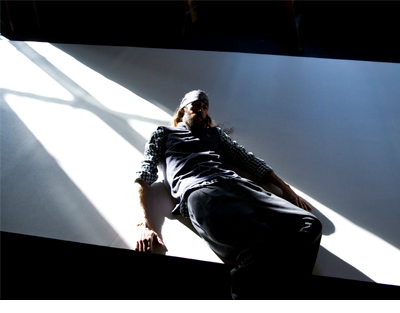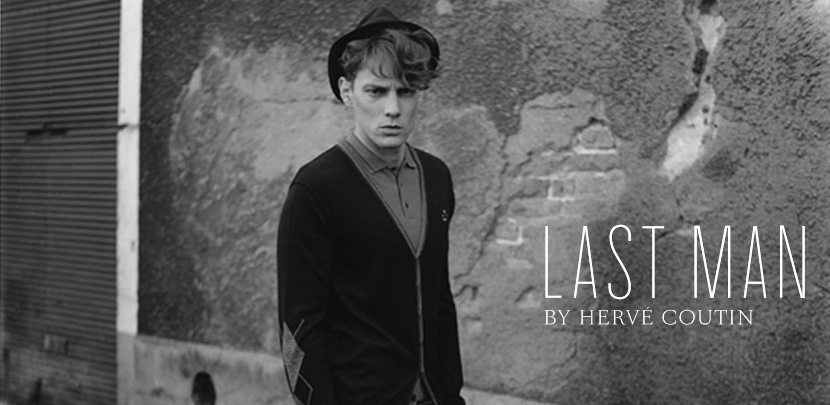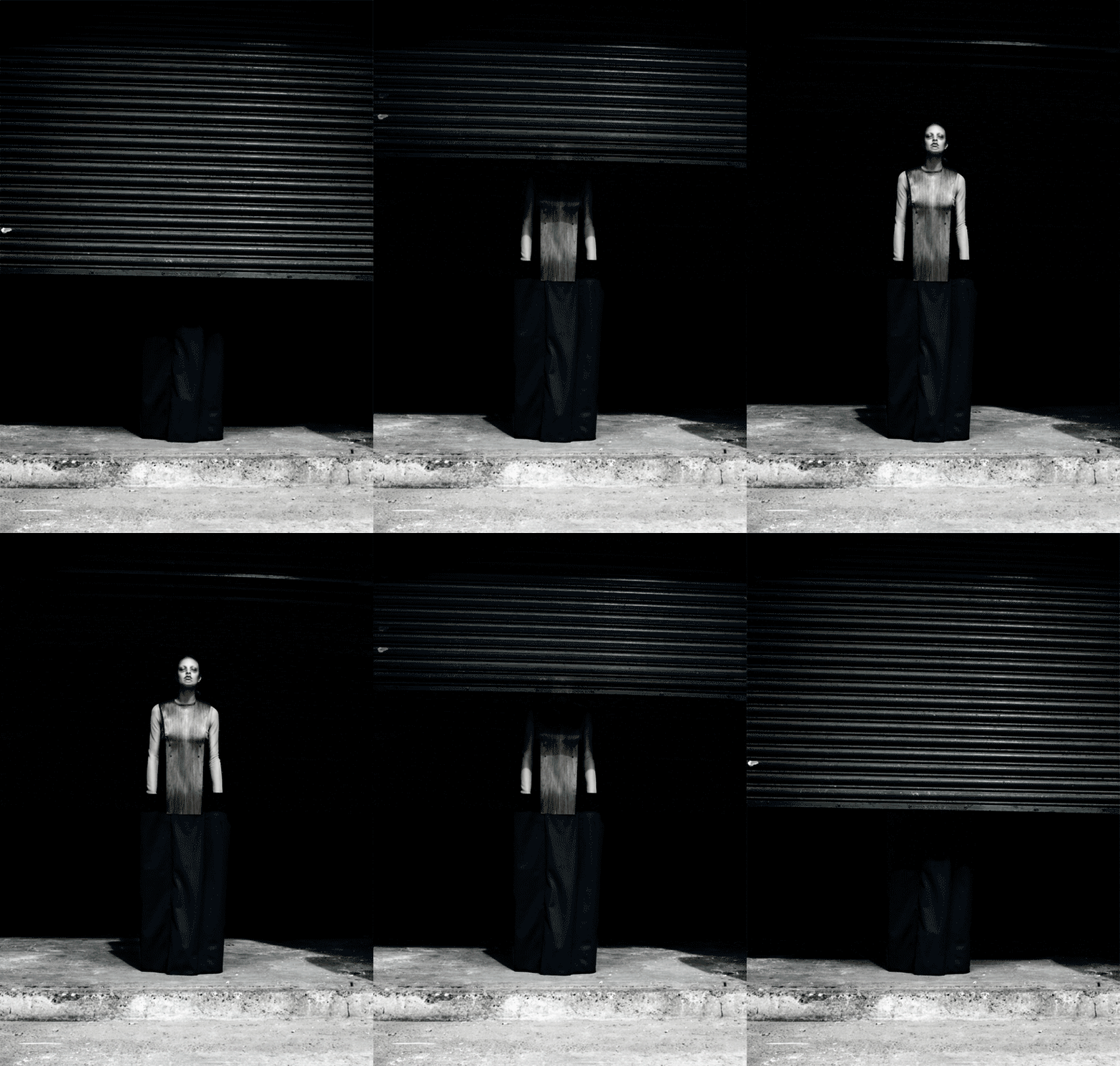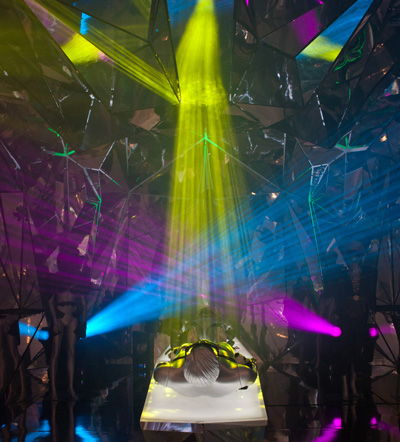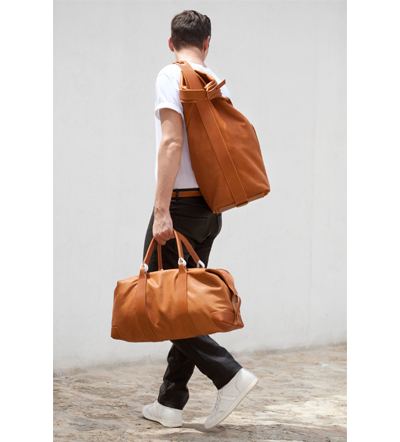

These days Robert Geller, a New York-based menswear designer, is busier than ever, which is just the way he likes it. Besides his successful eponymous line and a collaboration with Levi’s, Geller is launching a new retail venture, called Key Shop. The temporary store, a partnership between Geller and Greg Armas, the owner of the eclectic Lower East Side boutique Assembly, will feature a carefully edited selection of Geller’s products, many exclusive to the store.
Geller has quietly become a fashion fixture of the downtown scene, his slim and pale dandy aesthetic fitting well with skinny dudes of unspecified occupations that roam the streets below Houston and well east of Broadway. “I feel that the Lower East side is where the Robert Geller guy likes to be,” wrote Geller in an email message. “The area has a lot of stores and restaurants popping up, and is still developing nicely. The guys (and girls) there get our aesthetic and will understand the store. I feel like it is the most exciting area of New York right now.”
So, if you want your key (get it?!) Geller items, like a poncho made of cupro and cotton and suede ankle boots, they will be waiting for you at 129 Rivington St., but only until April 15, when the temporary shop will close its doors.

![]() |
|
BLOGS
Art ObservedArtco Eclectic Cow Fashionista Kempt Magculture |
|
PUBLICATIONS
Another MagazineGood Magazine Lost at E Minor Refinery 29 Rhizome S Magazine Superfuture |
MISCELLANEOUS
Charity: WaterRadio Nova Tiny Vices |
|
![]() |

Ever wanted to touch a cloud? Now you can. Because that’s what a Faliero Sarti scarf feels like in your hand. For Monica Sarti, the head designer, the tactile experience is of paramount importance – her company’s most popular fabric is a cashmere/silk blend that infuses the scarves with extraordinary softness.
L’Accessorio Faliero Sarti was founded in 1949 in Tuscany, Italy. It started out as a fabrics house, supplying the newly reborn Italian clothing industry with high quality textiles from its mill. As its reputation grew, so did the list of their clients, which now includes Chanel and Donna Karan.
But Monica Sarti wanted to take the company further than a mere textile manufacturer. Making accessories seemed like a first logical step, since Sarti already possessed extensive expertise in fabrics. Nevertheless, she wanted to push her obsession with manipulating the yarn further. I caught up with co-owner Federico Sarti at Pitti Uomo in Florence to discuss their fabric choices and methods of production. “We are famous of course for using traditional fabrics like cashmere, wool, and modal,” said he, “but we are now also experimenting with more innovative materials such as protein and bamboo.”

Irish designer Bernice Kelly launched Macha jewelry (named after her hometown in Northern Ireland) in 2007. Pretty without being too precious, the London-based line offers incredible rings and humble necklaces in simple materials like silver, gold plate, and gemstones. To craft her accessories (many of them unisex), Kelly antiques and textures the pieces for a worn-in look. It’s an aesthetic that sometimes renders pieces a little imperfect; a few designs are even fashioned by starting with an accidental shape or a carving mistake. But Kelly calls her vintage-inspired jewelry “classics of the future”. And some of these handmade pieces are even a little whimsical: crab-claw cufflinks, molar-shaped pendants, sterling silver rings shaped like string knots. Kelly’s own photography reveals the intricacies of the pieces. One ring boasts a huge nugget of a gemstone – or does it? Upon closer look, the stone is actually a ridged chunk of metal, set like a diamond. Past collections have drawn on diverse, historical contexts, more industrious than elegant, from the American roadtrip to Victorian mining. And as a label, Macha is truly about the work, quality over an image or a pretense. The modern brand regularly posts its newest, modestly hewn pieces on its Facebook page. Lately, Kelly has been advertising her chunky-stoned rings for Valentine’s Day.
Today is a sad day in the world of fashion. Alexander McQueen, the notorious British designer, passed away at the age of forty, cutting short one of the most illustrious creative careers. He apparently committed suicide just days after his mother passed on. He was supposed to present his next women’s collection in Paris in a month.
McQueen was a genius. He relentlessly pushed the boundaries of fashion, especially with his phantasmagoric runway presentations, shocking his audience not only by the sheer force of his imagination, but also by his willingness to engage controversial topics in the industry that is immune to seriousness. For the Fall/Winter 1995 collection, titled “Highland Rape” he reflected on the English rule of his native Scotland, sending out models in airy clothes that were shredded at the breast. For the Spring/Summer 2001 collection, McQueen tackled the behind-the-scenes tragedy of the picture-perfect model image, putting models in a reflective-glass house. It was narcissism bordering on insanity. As the finale, another glass box was presented with writer Michelle Olley, naked, her body fat, face hidden by a mask, hooked up to a life support machine and covered with moths. There has never been a more poignant commentary on image obsession in fashion, and there probably never will be.
Maria Cornejo, a Chilean-born designer, has long been an underground fixture in the fashion world. Not exactly famous, not exactly unknown, she has consistently put out beautiful womenswear since her club kid days in London three decades ago. After growing tired of London Cornejo moved to Paris and then Tokyo, finally settling in New York City in 1996, where she opened an atelier in Nolita under the name Zero. She has become known for her unconventional, fluid garments that may look perplexing on the hangers but morph and fall gracefully once on the body.
This season Cornejo decided to dip her toes into the overheating men’s fashion market by creating a capsule menswear collection, which she showed with her womenswear during the Spring 2010 New York fashion week. With admirable consistency she transferred her design signature into a concave-shaped rain jacket, a seamless one-piece shirt, an oversized sweater with dropped shoulder, and slim bias-cut pants, among other pieces. The resulting silhouette is perfectly laid-back – no easy task to achieve when everyone these days seems to be trying their hardest to look nonchalant. The fabrics echo the comfort of the slightly asymmetric cuts – soft cottons and spring weight wool are predominant. The muted and discreet colors – black, white, and navy – create a gentle quietness around the collection.

Ann Demeulemeester
Queen Ann is the last romantic left in fashion. In the 21st Century, she is the one designer who can speak of poetry in her work unselfconsciously. Perhaps this collection was Demeulemeester sensing that our world is becoming increasingly prosaic. Backstage after the show, Demeulemeester said, “I started this collection by imagining a duke. Left in his castle, cut off from the world, what would he wear?” The answer — long black coats, high-waist riding pants, and leather rope belts. The tall young men Demeulemeester sent down the runway were every bit uninvolved, lost in their own thoughts, lost in their own clothes, lost in their own world. These days, Demeulemeester likes to puncture her usual black and white palette with a choice of color. For this show her color of choice was olive-gray, which translated well into the capes and asymmetric, voluminous jackets.
Black is the most misunderstood color. In fashion, black has been co-opted by two groups of people: the Balmain-sporting fashionistas who think that chic is a value in itself, and the misguided (by Hot Topic) teenagers who worship Satan and Marilyn Manson in the safety of their suburban homes. But black is not the color of chic or nihilism. For Tatsuro Horikawa, the young Japanese designer behind the cult clothing label Julius, black is the color of depth. It is not there to promote aggression and destruction – the pop version of black – but to display his awareness of the world that is subject to aggressive and destructive forces. And, as unexpected as it might sound, it is also a color of hope. “Black is the color of complete and utter grief,” says Horikawa’s manifesto, “and redemption through atonement.” This view is a kind of existentialism – the idea that we alone are responsible for our fate and carry the full burden of responsibility for our actions, and thus must bear witness to the world’s evil. This view can be easily traced in Horikawa’s uncompromising designs – the oiled leather jackets, heavy jeans with multiple pockets, and drapey, shredded tops. Their purposeful ruin is the reflection of our imperfection. But these clothes are also indestructible, like the human spirit.
Horikawa started out as a graphic designer in the late ’90s, forming a Tokyo-based art collective that produced multimedia installations. He considers the clothes to be the project’s extension.
One glance would make you think Los Angeles-based designer Austin Sherbanenko specializes in outfitting metal bands or partying with Andrew W.K. His clothing does indeed carry a strong goth-rock influence; but that flavor, mixed with good old-fashioned skilled design, makes for a mature collection that’s more haute than Hot Topic. Sherbanenko’s brainchild since 2007, Odyn Vovk officially launched with its Spring/Summer 2009 collection. Now with his Spring/Summer 2010 collection, Confined Translation, Sherbanenko is a designer with a solid aesthetic; he knows his audience because he is his audience. This season in particular tells the story “of past events: distant, near, and natural.” Symbolism in the collection includes “dirt-ridden streets, industrial landscapes, and sounds of music.” Odyn Vovk, Ukrianian for “One Wolf”, suggests strength, independence, and resourcefulness. Odyn Vovk’s site states that in “Celtic tradition, Wolf represents learning, loyalty, intuition, and the shadow … cunning, wisdom, searching, dreams, magic, transformation, death, rebirth, and protection.” Sherbanenko chooses black to dominate his collections because the solid color allows design intricacies to shine through. Structure is key, whether it’s the subtle drapery of loose, asymmetrical hoodies or the stronger contour and weight of a leather-sleeved jacket. The familiar and looser shapes ground the pieces, while classic shapes with minor twists – a zip-up jacket with a collar that could cover half your face, or a dress-length zippered vest – add elements of character, creativity, and construction.


Facebook
Digg
MySpace
Reddit
del.icio.us
LinkedIn
Mixx
Yahoo! Buzz
StumbleUpon