Design March 9, 2010 By Nika Knight

rubikon_coverrubikon_title

In the digital age, photographs are everywhere and all the world has a camera. At the same time, classical photography is being forgotten and, consequently, has become even more expensive as pixels replace actual film.
     Here to remind us of photography’s most rudimentary origins is Czech designer Jaroslav Jurica and his “Rubikon Pinhole Rebel”. Published under a Creative Commons license in PDF format, anyone with access to the internet and a printer can print out and glue together the pieces to form a functioning pinhole camera.
     A pinhole camera, whether made of paper or plastic, is essentially a hand-held camera obscura. Latin for “dark room”, the term camera obscura refers to the premodern discovery that when light was filtered into a dark room through a small aperture, images would be projected upside-down onto an opposing wall or screen. Aristotle, da Vinci, and Chinese and Arabic philosophers dating back to the tenth century B.C. understood and wrote about the phenomenon that laid the groundwork for modern image-making.
     Thanks to the Rubikon Pinhole Rebel, three thousand years later the haunting, unexpected beauty of simple photography is made as easy for us to explore as it was for the ancients.

1 2 3 4 5 6 7


Design, Fashion February 15, 2010 By Andy Wass

bkelly_coverbkelly_title

Irish designer Bernice Kelly launched Macha jewelry (named after her hometown in Northern Ireland) in 2007. Pretty without being too precious, the London-based line offers incredible rings and humble necklaces in simple materials like silver, gold plate, and gemstones. To craft her accessories (many of them unisex), Kelly antiques and textures the pieces for a worn-in look. It’s an aesthetic that sometimes renders pieces a little imperfect; a few designs are even fashioned by starting with an accidental shape or a carving mistake. But Kelly calls her vintage-inspired jewelry “classics of the future”.  And some of these handmade pieces are even a little whimsical: crab-claw cufflinks, molar-shaped pendants, sterling silver rings shaped like string knots. Kelly’s own photography reveals the intricacies of the pieces. One ring boasts a huge nugget of a gemstone – or does it? Upon closer look, the stone is actually a ridged chunk of metal, set like a diamond. Past collections have drawn on diverse, historical contexts, more industrious than elegant, from the American roadtrip to Victorian mining. And as a label, Macha is truly about the work, quality over an image or a pretense. The modern brand regularly posts its newest, modestly hewn pieces on its Facebook page. Lately, Kelly has been advertising her chunky-stoned rings for Valentine’s Day.

1 2 3 4

 
BLOGS
Art Observed
Artco
Eclectic Cow
Fashionista
Kempt
Magculture
 
PUBLICATIONS
Another Magazine
Good Magazine
Lost at E Minor
Refinery 29
Rhizome
S Magazine
Superfuture
MISCELLANEOUS
Charity: Water
Radio Nova
Tiny Vices


Design February 9, 2010 By Andy Wass

paulsmith_coverpaulsmith_title

In his three decades of designing, Paul Smith has teamed up with everyone from Oakley and Burton to Triumph Motorcycles. Now the British designer has released a collaborative partnership with Apple. The Paul Smith for Apple “luggage and accessory “ capsule collection includes leather iPhone and iPod cases; Mini Cooper Macbook sleeves and shoulder bags; and knit iPod socks with Smith’s signature multistripe pattern. The bags, cases, and sleeves are available in different sizes to accommodate different kinds of Macbooks and iPods, and sturdy materials and stitching keep your valuable electronics safe. Impressively, the menswear icon has found another way to keep his designs relevant for a new generation. Smith stays true to form with this small line, utilizing classic shapes and simple leathers, and injecting his own personality with bright colors. 

Next

Design, Greenspace February 8, 2010 By Nika Knight

bamboobike_coverbamboobike_title1

There’s a distinctive project in the works to bring sustainable development to developing countries, and it combines two things rarely found in the same sentence: bamboo and bicycles. The Bamboo Bike Project aims to help people in impoverished countries by teaching them how to make their own bikes out of — that’s righ t— bamboo.
     Bamboo is the largest member of the grass family and the fastest growing plant on earth (shoots can grow more than two feet per day). The self-replenishing speed with which it grows makes it an ideal and sustainable construction material in impoverished, tropical countries. Or anywhere for that matter. It’s also exceptionally strong, and makes a surprisingly lightweight bicycle. Co-founders John Mutter and David Ho initially learned to make the bikes from a man who wanted to sell the bikes as a boutique item to wealthy customers. Rather than keep the bamboo bikes a niche item, Mutter says, “Our objective is to make them in large numbers and sell them for as little as possible.”
     “I’ve been to Africa and some other poor places,” continues Mutter, “and if you’ve ever been to a place like that you realize that while bicycles [in rich countries] are just sort of personal transportation and a means of getting exercise, anywhere where incomes are low they represent a lot more than that.”

1 2 3 4 5 6


Design, Greenspace February 4, 2010 By Jennifer Pappas

filler24

viesso_cover
Photography courtesy of Viesso

viesso_title

Los Angeles has always had a knack for turning one man’s trash into another man’s table. Fortunately, custom furniture gurus, Viesso, know how to make it look great too. Constructed entirely out of reclaimed wood beams salvaged from rundown LA buildings, Viesso’s new Koper table is an eco-savvy cross between Jenga and a Rubik’s Cube. Fun, earthy, and versatile, the Koper has a certain charm not typically attributed to home furnishings. Viesso is something of a pioneer in furniture design, reconstructing the entire shopping process by encouraging individuality, efficiency, and smart innovation. Far from sifting through a showcase full of generic furniture, each table, sofa, and bed is customizable, offering earth-friendly options and materials. To further reiterate Viesso’s commitment to the planet, all products are manufactured locally. True to Viesso form, the Koper table ranges in sizes from 16” X 16” to 36” X 36”, with the option of a marble top. Custom tables start at $244.

Next

Design, Fashion December 14, 2009 By Charlie Fish
uncommon_cover

uncommonmatters_title

When Uncommon Matters debuted its line of couture porcelain accessories, designers Amelie Riech and Jana Patz cheekily complemented the showroom installation with a soundtrack of breaking and clattering porcelain to underscore the fragility of their award-winning designs. The “Handle with Care” collection, as it is called, adeptly merges the idea of traditional crafts and materials taking shape to become an entirely new, modern creation.
     A man’s stiff shirt collar, for instance, becomes the inspiration for a series of platinized neckpieces, creating striking — and reflective — accessories that could perhaps be seen as a variation on the “boyfriend shirt” look. An entirely porcelain necklace, on the other hand, is designed with chain links in mind, and delicately clinks and clanks when in motion. Chunky porcelain bracelets and sleek neck cuffs round out the product line, which has continually graced the pages of many a fashion editorial in 2009.

1 2 3 4 5

Design December 4, 2009 By Charlie Fish

eggcollectivecovertreestump_title

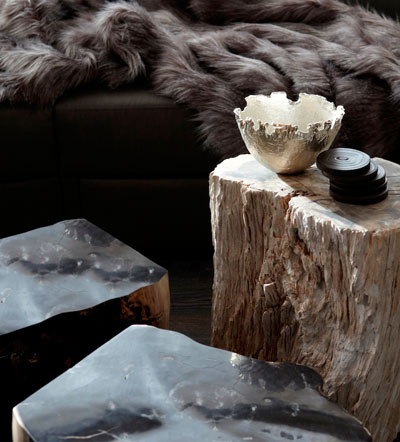
Given the current emphasis on green design, it’s only natural that the tree stump should find its way into home décor and furniture design. Wood stumps have been a recent source of content for DIY bloggers and designers, and have even been co-opted by retail furniture stores like West Elm (in gold, of course). But Stephanie Beamer, co-founder of the all-girl furniture design crew Egg Collective, insists that their designs, including a stump side-table lamp, are rooted in architecture and are more about functionality and form than about following green trends. Citing pre-Danish modernism and French Art Deco styles, Beamer views furniture design “as a microcosm of the whole that is architecture.”
     The Egg Collective girls first met in wood shop while in architecture school in St. Louis. Upon encouragement from a professor, the ladies teamed up to begin creating innovative furniture pieces centered around ideas and creativity, not commerce and mass production. Following a particularly nasty series of storms in St. Louis, the Collective used fallen sycamore trees from local parks to create a series of limited edition side-table lamps that have since generated consistent buzz.

1 2 3 4 5


Books, Design December 3, 2009 By Mark Steffen
putnam_cover
Nicholas Koening courtesy of Morgan Hotel

putman_title

You see the influence of some people every day: Gandhi and the idea of peace, President Obama and the soon-to-be-sweeping health care reform, Carl Sagan and the thought of ourselves as small. All pretty big ideas. What you may not see or realize is that there are people who very directly influence the way you dress, the way your favorite store is decorated, and the fact that you can get away with a tie and jeans in this day and age. Enter Andrée Putman.  Blending the high and the low into a beautifully unique and practical product, Putman describes her own best works as “the perfect balance between discipline and revolt.”
     Rizzoli Publications has released a definitive look, Andrée Putman: Complete Works, at the woman who in the 1980s brought to light the idea of high-end chic mixing with plebeian materials. Her career includes redesigning hotels, department stores, residences, and, recently, an entire thirty-one floor apartment skyscraper in Hong Kong, as well as a plethora of product design. 
     The book, written by Donald Albrecht (curator of architecture and design at The Museum of the City of New York) and Jean Nouvel (award-winning architect) offer the ultimate look at all of her works in a staggeringly winsome package: perfectly-square, minimal, robust in content, and all-around attractively built — just as Andrée would want.

1 2 3 4 5 6 7

Design November 9, 2009 By Andy Wass

freitag_cover2freitag_title

Zurich-based Freitag has just added two new messenger bag styles to its collection of industrial accessories: the F76 Leo bag (for 13” laptops) and the F77 Ben bag (for 13” and 15” laptops). Each unisex style is available in eighty different colorways, and the bags’ versatile design allows the user to carry it as a tote, a shoulder bag, or a crossbody messenger bag. Like the label’s other styles, the boldy-colored Leo and Ben are handmade from used seatbelts and truck tarpaulins. They continue Markus and Daniel Freitag’s legacy of durable, water-resistant messenger bags. Freitag’s longtime dedication to repurposing materials will appeal to the eco-conscious customer, while the new bags’ efficient shape and size will please computer-users from bloggers to businessmen. Great bags for bicyclists and commuters, using the Leo or the Ben is a reliable and trendy way to take your work home with you.

Next

Design, Greenspace October 22, 2009 By Hannah Bergqvist
urnatur_cover3
Photography by Ulrika Krynitz

filler5urnatur_title

It’s been great to see a growing number of eco-lodges offering a more sustainable holiday alternative surface over the last years. As much as they all deserve recognition for their environmental awareness it’s hard not to get excited when stumbling upon one with that little bit of extra. One like The Wood Hermitage, located in the leafy Holaved forest in the south of Sweden. The Hermitage — surrounded by lakes and the mountain Omberg — has welcomed guests to its spartan facilities since May 2007. Offering simple luxury, the lodge mixes traditional Swedish craftsmanship with Japanese-influenced interior design. The small handcrafted wooden huts and cabins — some of them with grass covered roofs — work in harmony with the surrounding environment. All houses except for the main cabin were built using trees felled by the storms Gudrun and Per in 2005 and 2006. The use of electricity is sparse — there is only enough for running a single 15W light bulb in the kitchen and the solar panel in the bathing house. Both the sauna and the wooden bathtub are wood-fired. On top of such a cozy living space, The Wood Hermitage also embraces the local food trend, with all the food coming from their own garden or nearby farmers.

1 2 3 4 5

Water is scarce, find out more with charitywater.org