
Greenspace March 4, 2010 By Carly Miller

filler

Photography Courtesy of John Todd Ecological Design

Photography Courtesy of John Todd Ecological Design

fillerjohntodd_title
Ecological design technology is based on the idea that manmade “machines” can be harnessed to mimic biological systems, giving us the power to restore environmental contaminants and neutralize the build-up of waste on the planet.
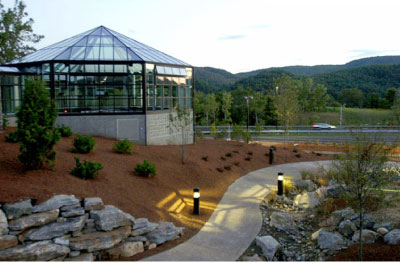
     John Todd, a marine-biologist, inventor, and designer, is using eco-technology to address the global wastewater crisis. Todd applies principles of bio-mimicry to create Eco-Machines, which are networks of biological systems built to strategically transform industrial sewage into usable water. Eco-Machines are custom built for size requirements, but they all look like a series of connected fish tanks, each tank a separate treatment zone utilizing anaerobic, flow-equalization, anoxic, and aerobic processes. Water flows through the tanks and sifts lastly through an effluent filter, such as a constructed wetland or fluidized bed, to catch leftover solids. All of this is accomplished without the use of chemical-based inputs that are used in sewage treatment plants, which eject chemically imbalanced water back into water streams, starving our rivers of oxygen with unwanted algal blooms.
     Living Machines are built to recreate the complexity of ecosystem relationships, which are fostered between microscopic algae, bacteria, protozoa, fungi, zooplankton, minerals, snails, fishes, and plants.

1 2 3


Architecture, Greenspace February 16, 2010 By Carly Miller

filler26

lacasa_cover
Photography courtesy of Alfredo Santa Cruz

filler26

lacase_title

The home is where a culture begins, and the members of the Alfredo Santa Cruz family are re-defining our culture/environment relationship by building homes from unlikely materials. The Casa De Botellas was created by the Santa Cruz family in Puerto Iguazu, Argentina, as a tool for promoting ecological and social responsibility. Although they are not architects or engineers, the Alfredo Santa Cruz family successfully designed their portable structures to be accessible, simple, and creative down to the last detail.
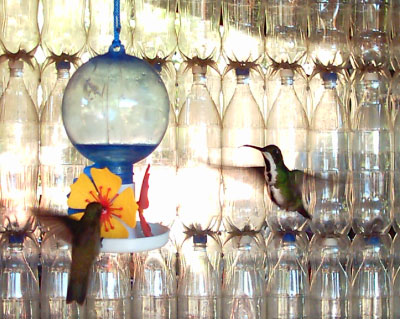
     The structures of the house and every piece of furniture inside are constructed entirely from used plastic. PET remains intact for 300 years, which is longer than cement, and more durable. This is an ingenious re-use that turns the hazard of slow decomposition into an asset.
     The walls are made from 1,200 PET plastic bottles, which support a 1,300-piece Tetra Pack roof holding 140-piece CD jewel-case doors and windows that surround plastic-bottle couches and beds. A self-invented casting technology keeps the bottles fused together without obstructing the visual symmetry.
     Creating environmental solutions from the ground up, the Cruz family provides free home building courses to address both trash and housing scarcity in Latin American countries, “realities that nobody can hide”.

1 2 3 4 5

 
BLOGS
Art Observed
Artco
Eclectic Cow
Fashionista
Kempt
Magculture
 
PUBLICATIONS
Another Magazine
Good Magazine
Lost at E Minor
Refinery 29
Rhizome
S Magazine
Superfuture
MISCELLANEOUS
Charity: Water
Radio Nova
Tiny Vices


Greenspace December 30, 2009 By Carly Miller

fillers16bkfarm_coverfillers16bkfarm_title

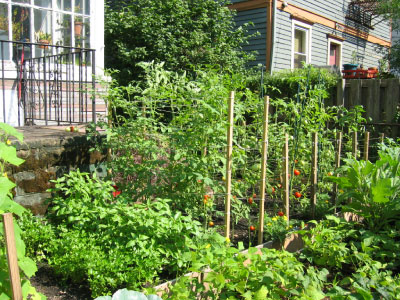
In the 1800s, Brooklyn and Queens had the highest density of agricultural land in New York City. Today, the city landscape has changed, with total unused land of about 10,000 acres, all broken up into thousands of vacant lots, private backyards, and underutilized squares. Space in New York City is a highly valuable commodity. Walking down any city street, one can see urban dwellers creatively squeezing every inch out of the precious space they occupy. To BK Farmyards, a Brooklyn-based urban farming business, these structural limitations are the seedlings for a radical, community-based farming solution to food-sustainability issues.
     Contrary to our current chemical and land intensive agri-business model, it doesn’t take a lot of land to feed people — 250 square feet can feed 4-5 people for 6 months, according to BK Farmyards owner Stacey Murphy. BK Farmyards converts underutilized urban land, from private backyards to traffic circles, into edible gardens that grow crops, culture, and community. Their vision is large social change through use of tiny spaces: transforming the design and function of small plots into a decentralized, agricultural network connecting food producers, landowners, and consumers.

1 2 3 4 5 6