Art July 6, 2010 By Rachel A Maggart

filler113 MARIKO MORI

 Pratibimba 1, 1998 - 2002. All artwork by Mariko Mori. Images courtesy of Galerie Perrotin. (Click to Enlarge)

Pratibimba 1, 1998 - 2002. All artwork by Mariko Mori. Images courtesy of Galerie Perrotin. (Click to Enlarge)

marikomori title MARIKO MORIForget space travel, time capsules. Past, present, and future are but alter egos video artist Mariko Mori (森万里子, b. 1967 in Tokyo, Japan) embodies in the glow of a moon-age daydream. Now showing through August 1, Kumano (1997-98) celebrates the Asia Society’s recent acquisition of a pivotal work in the artist’s oeuvre. Affirming her knack for re-invention and media overlay, Kumano witnesses Mori’s quirky jumble of the temporal continuum in fairy, shaman, and angel incarnations. As the exhibition flows from traditional layout to meditative chamber and theater, Mori’s own spiritual journey (no whimsical diversion but a twelve-hour trek) to the revered 8th century pilgrimage site is illuminated. An ancient stone statue, 18th-century golden Tibetan icon and Japanese silk scroll are among the treasures she cycles through with shimmering, looping vocals, as if to reference the non-linear arc of Shintoism and mutability of adopted religions. Once having described her aim to “connect [ancient things] with contemporary life through the technology we have now”, Mori implements aural layering and digital imaging to splice epochs of Asian belief systems.

1 2 3 4 5 6 7


Art May 26, 2010 By Rachel A Maggart

filler74 Rosalind Solomon

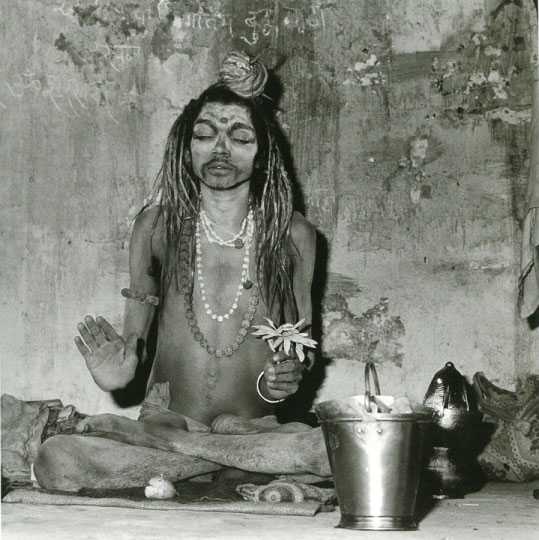
A Holy Man, Katmandu (1985). All photography by Rosalind Solomon. (Click image to enlarge)

A Holy Man, Katmandu (1985). All photography by Rosalind Solomon. (Click image to enlarge)

rosalind titel Rosalind SolomonThough hardly a stranger in photography circles, Rosalind Solomon is gradually gaining prominence in the mainstream. After four decades trekking Japan, Guatemala, Peru, India, Nepal, South Africa, and Poland with a medium format point and shoot, the veteran photographer and recent octogenarian is being celebrated in New York in multiple ways. Her single-artist exhibition, RITUAL (now on view at Bruce Silverstein Gallery through June), and the MoMA’s Pictures by Women: A History of Modern Photography (taking place nearly twenty-five years after her first Ritual show at the MoMA) feature the artist in bold documentary form. Reflecting an ongoing theme in her work, RITUAL documents private meditation and communal rites binding people of various cultures. A humanist to the core, Solomon captures expressions sharpening the ebb and flow of ordinary existence.
     Known for her window-into-the-world immediacy rendered via the use of square format and strobe lighting, Solomon’s work has often been likened to that of Diane Arbus (with both women’s penchant for deviant subject matter only augmenting the comparison — the former favoring battered baby dolls, the latter, society’s castoffs).

1 2 3 4 5 6 7 8

 
BLOGS
Art Observed
Artco
Eclectic Cow
Fashionista
Kempt
Magculture
 
PUBLICATIONS
Another Magazine
Good Magazine
Lost at E Minor
Refinery 29
Rhizome
S Magazine
Superfuture
MISCELLANEOUS
Charity: Water
Radio Nova
Tiny Vices


Art May 4, 2010 By Rachel A Maggart

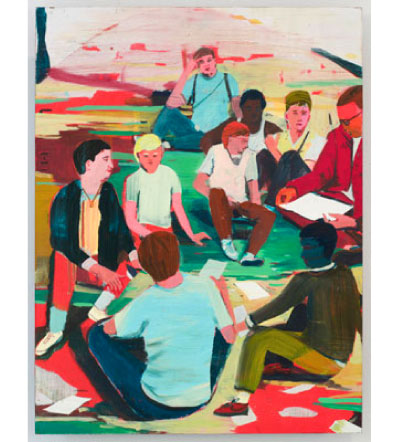
Jules de Balincourt, A Few Good Men, 2010. All images courtesy of Jules de Balincourt, A Few Good Men, 2010

Jules de Balincourt, A Few Good Men, 2010. All images courtesy of Jules de Balincourt, A Few Good Men, 2010

julesben title2 Jules de Balincourt

If you’re searching for metaphysical rejuvenation, Jules de Balincourt mixes a potent visual tonic of apocalyptic sunbursts and fractured fortunetellers. Continuing his international successes in Paris, London, and Tokyo, the lithe 37-year-old graced Deitch’s cool gallery interiors last month with sixteen figurative and abstract paintings, marking his most extensive exhibition to date. Despite de Balincourt’s politically tinged oeuvre, his recent works have been decidedly more meditative, measuring the imprint of technology in a process of thoughtful internalization. Dense iterations of life, chaos, and computers, de Balincourt’s art presents content and form in a deliberate DIY, faux-naïf aesthetic. Oil and acrylic media, stencils, tape, knives, and spray paint are employed in equal measure.
     Besides a penchant for lush settings and a Day-Glo palette, de Balincourt’s psychedelic-cum-futuristic art reveals his mélange of influences. Incorporating a French pedigree and California culture, it appears richly idiosyncratic (think a hallucinogenic hike through the Barbizon woods). Part humanitarian, part provocative, De Balincourt’s creative output could be seen to reflect his extracurricular activities, including the temporarily defunct Starr Space (a Brooklyn hub for yoga and gallery denizens alike) and Bush-era protests.

1 2 3 4 5 6 7 8 9 10 11

Art April 30, 2010 By Rachel A Maggart

Caption

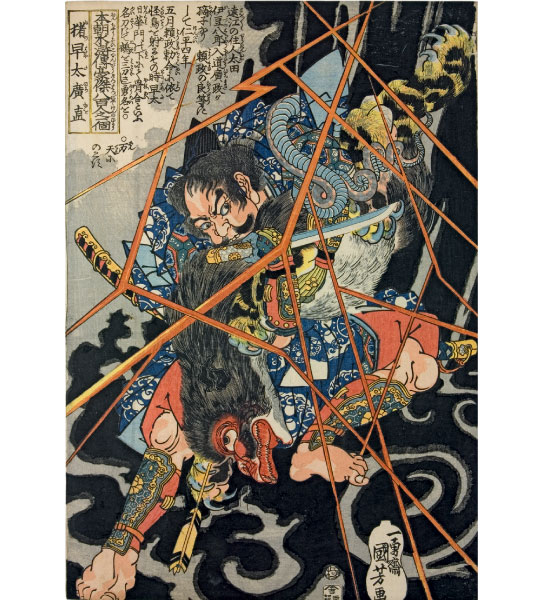
Mount Mongaku Does Penance in Nachi Waterfall, 1851. All artwork by Utagawa Kuniyoshi, All photography © Trustees of the British Museum. Courtesy of Japan Society. (Click Images to Enlarge)

graphicheroestitle Utagawa Kuniyoshi

From embattled warriors to writhing sea creatures, ukiyo-e aficionados and comic book collectors will find their niche in the fearsome and fantastic, now on display at the Japan Society through June 13. Showcasing exquisitely detailed woodblock prints by the godfather of modern video games and anime, Graphic Heroes, Magic Monsters: Japanese Prints by Utagawa Kuniyoshi (1797-1861), from the Arthur R. Miller Collection,” is a not-to-be-missed exhibition organized by Timothy Clark, head of the Japanese section of the British Museum. An action-packed show grouped in warrior, landscape, kabuki, beautiful women, and kyoga (literally “crazy pictures”) categories, the 130-print pictorama includes gems from the collection of NYU legal scholar Arthur R. Miller, rough sketches unearthed from the Victoria and Albert Museum and even onsite drawing by the mangaka-in-residence Hiroki Otsuka. Moved by the master printmaker, Otsuka will create a full-length comic strip as an interactive “meta-narrative” for exhibition goers.
     Having created roughly 10,000 prints, Kuniyoshi can be viewed a powerful Pop Art progenitor who worked to satisfy the insatiable appetite of Edo period manga fan equivalents (at a rate of two soba platefuls per print, scholars estimate). But apart from his staggering output, the artist is celebrated for his spirited defiance and slew of creative tangents despite his censorial 1840s Tokugawa shogunate.

1 2 3 4 5 6 7 8


Art April 1, 2010 By Rachel A Maggart

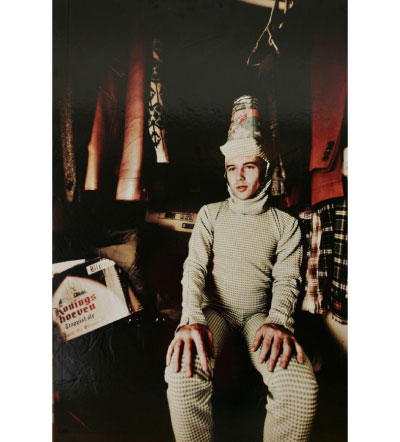
Dunce Man, All Photograhy courtesy of and by Tam Tran.

Dunce Man, All Photograhy courtesy of and by Tam Tran.

TAMTRAN TITLE Tam TranAn exercise in Biennial belt tightening, the Whitney’s “2010” isn’t quite the visual juggernaut of years past. Pared down to fifty-five artists seeking to convey the anxiety and hope of the last two years, the exhibition is an understated paean to the present. On the modest roster is Vietnamese-born Tam Tran, a 23-year-old photographer whose contribution to a Memphis group exhibition first caught the eye of associate curator Carrion-Murayari. Tran, whose use of stark color and shadow recalls William Eggleston’s saturated depictions of the region, is quirky and disarming in her spontaneity and collaborative approach. In photographing her nephew for the Raising Hell series chosen for the show, the artist remarked, “If I see something I liked I would yell, ‘HOLD!’ and immediately push the shutter button before the moment was gone.” Often her work involves costuming or formal manipulation to emphasize ambiguous roles and narratives. Pool halls, mini marts, backyards, and her body act as canvases for studies in shifting identity and dichotomy. In a self-portrait cycle, for example, the artist transmogrifies from diminutive doll to powerful protagonist. While throughout Raising Hell the artist’s nephew wields a stick against a palpable yet invisible foe in alternating poses of victory and surrender. Rich in metaphorical content, the photograph Battle Cry from this series appeared prominently in media outlets covering the Biennial. “From the stance of an adult, the boy warrior is living out an instance of our childhood that we’ve lost,” Tran comments. It is a layered perspective on innocence, articulating fear and reassurance, force and restraint.

1 2 3 4 5 6

Art March 19, 2010 By Rachel A Maggart

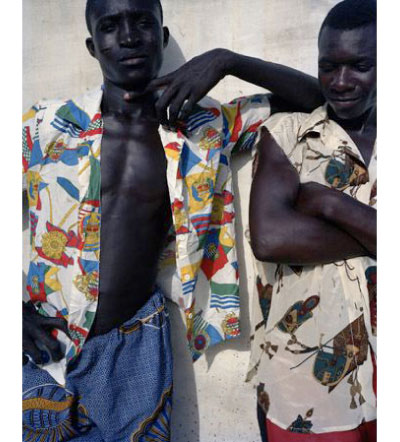
Gold Coast All photography by Viviane Sassen courtesy of Danziger Projects.

Gold Coast All photography by Viviane Sassen courtesy of Danziger Projects.

sassen title VIVIANE SASSEN : new african portraiture

As global consumers we have become accustomed to beauty with exotic trimmings. For French VOGUE and i-D photographer Viviane Sassen, however, fashion trends are not to be confused with a deeper heartfelt mode of expression. Now on view at Danziger Projects through Apr 10 are selections from her three series ‘Die Son Sien Alles’ (The Sun Sees Everything), ‘Flamboya’, and ‘Ultra Violet’. Not quite haute couture, not quite documentary, Sassen’s photographs are the result of directed African pilgrimages and fall into an enigmatic category incorporating personal memory, imperialism, and sensual beauty. Evoking South Africa, Zambia and East Africa (Kenya, Uganda and Tanzania), they intimate the mythologized ‘Other’ but moreover signify the fruits of close collaborative efforts. African models bathed in shadows or fog, configured in abstract sculptural formations, or marked with strident color, dually invoke indigenous spirituality and colonial superstition. In Sassen’s world of magical realism, bodies overlap or emerge in lush, unusual settings, intertwining the oft-illusory politics of ethnicity and aesthetics.

The artist discussed her work and ties to Africa in a candid interview with PLANET

1 2 3 4 5 6 7 8

Art March 1, 2010 By Rachel A Maggart

filler32 Wolfgang Tillmans

Wolfgang Tillmans, Installation View. (Photography courtesy of Andrea Rosen Gallery)

Wolfgang Tillmans, Installation View. (Photography courtesy of Andrea Rosen Gallery)

filler32 Wolfgang Tillmansfiller32 Wolfgang Tillmans
wolfgang title Wolfgang Tillmans

In this digital age dominated by free media-sharing and instant mobile uploads, photographer Wolfgang Tillmans restores hope in our fading ability to discern beautiful images. German-born Tillmans, known for his rapturous club photos of British i-D, brings to Andrea Rosen Gallery through March 13 a show with the full intensity and point-and-shoot bravura of those seminal nineties spreads. Pictures in the Place of Others, featuring seemingly extemporaneous snapshots of contemporary life, captures tender expressions, natural phenomena, and shimmering skylines. Witness Heptathlon, wherein Tillmans catches an athlete in momentary abandonment; in Ostgut/December Edit (at the entryway of the installation) he assembles chaos with signature panache. When so many photographs bear the markings of deliberation, Tillmans’ appear purely spontaneous. His work thus retains a captivating, timeless quality (perhaps accounting for the unlikely correlations drawn between his irreverent hipster and the Caravaggio nude). An exercise in unkept formalism, Pictures in the Place of Others finds balance in its unapologetic use of color and premeditated, if imperceptible, exhibition layout.
“In a way, to reconcile or address the randomness of the world today is the biggest task, to let it all in, but still hold course…. I’m interested in the mind being stretched by trying to pull this world of pictures together.”

1 2 3 4 5


Art February 18, 2010 By Rachel A Maggart
magda cover Magda
San-Zhr Pod Village, Taiwan, 2008 (Photography by Magda Biernat courtesy of Clic Gallery)

filler27 Magda
magda title2 Magda

In a world subsumed by top tens and to dos, Polish-born photographer Magda Biernat takes aim at our itemized approach to travel. Now running at Clic Gallery through March 2 is her Continental Bounce, culled from a year of transcontinental exploration. Documenting remote spaces through a local lens, Biernat captures Kenya, Australia, and everything in between. Oceanic vistas aside, though, Continental Bounce is no ordinary tourist brochure. Subtly elusive, the exhibit disorients even the most surefooted of jetsetters. Take Tipi Resort in Swakopmund, Namibia, for example, which features an African chalet seemingly plucked from the Sonoran desert. Avoiding major sites in favor of the interstices that define the journey, Continental Bounce is a testament to shifting borders and cultural ambiguity. We sat down with the artist to discover more.

What draws you to interiors and architecture?

Early on, I noticed that I have a good eye for structures and geometrical shapes and combinations of colors. That’s why I decided to go into architecture commercially…. Even though I love good portraits of people, first of all I am taking pictures of spaces.

1 2 3 4 5 6 7 8 9

Art, Events February 4, 2010 By Rachel A Maggart

fillter2 The Year in Pictures

danzinger cover The Year in Pictures
All images courtesy of Danziger Projects unless otherwise noted.

fillter2 The Year in Pictures

danzinger title The Year in Pictures

Economically, 2009 could be viewed a debacle. Fortunately gallery owner and photography enthusiast James Danziger does not measure achievement in terms of the Dow. Validating 2009 with The Year in Pictures, now on view at Danziger Projects through February 27, Danziger displays sublime photography from his personal blog. The exhibition, aimed to provide exposure to contemporary artists, allocates three walls to “photographers who would otherwise not be known to New York gallery going audiences” and one for legends in the medium. Resulting from a selection process boiling down to two criteria — quality and originality — the show is a highly satisfying group of images spanning decades, nationalities, and aesthetics.
     Featuring work by fifteen photographers — Jowhara AlSaud, Chan Hyo Bae, Thomas Bangsted, Mandy Corrado, Stephen Gill, Joseph Holmes, Alejandra Laviada, Greg Miller, David Schoerner, Patrick Smith, Tommy Ton, Scout Tufankjian, Oliver Warden, Katherine Wolkoff and Tsukasa Yokozawa — representing nine countries — Saudi Arabia, Korea, Denmark, Britain, Mexico, Japan, France, Canada, and the US — The Year in Pictures is a compendium of rich artistic perspectives. United solely by the element of color — a mode of photography almost taken for granted now — works were chosen at Danziger’s discretion to encompass a myriad of subjects and techniques.

1 2 3 4 5 6 7 8 9 10