


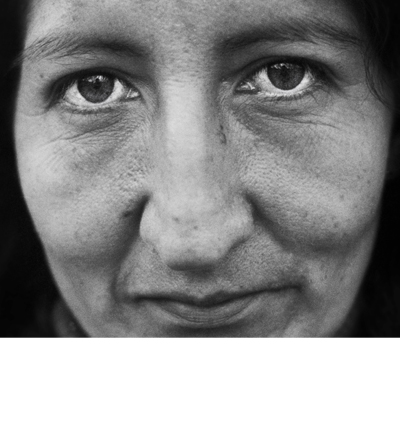

It can be hard, sometimes, to wrap our heads around the injustice faced by people overseas. We know that countries like Iran, Afghanistan and Burma are repressive places, but news stories about them can seem a little abstract and faraway. Without personal stories, we’re left with just a vague sense of what the injustice means.
That’s where an event like the Human Rights Watch Film Festival comes in. Now in its 22nd year, the festival (which takes place from June 16-30 in New York) shows how individuals are affected by repression and injustice. Powerful and personal, these films take us beyond the surface, looking into the lives of ordinary people with insight, sensitivity and humor.
You might get a chill, for example, when you watch the story of Naty, a Peruvian maid working in Spain to support her family–then realize that plenty of Natys have cleaned your room and brought you food. Mikael Wiström and Alberto Herskovits’ film Familia shows Naty’s intense loneliness and the price paid by her family in Peru, especially her young son. It’s a story that’s heartbreakingly familiar, yet intensely individual too.
(more…)
 Facebook
 Permalink
 Digg
Digg Reddit
 LinkedIn
 StumbleUpon
 Tumblr
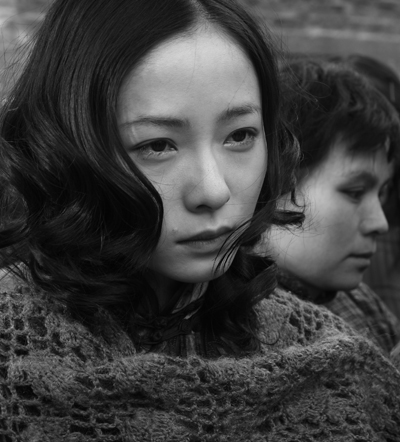


In China, challenging the official view of history can be a dangerous business. Recently, director Lu Chuan found this out when his film, City of Life and Death, was released. “Traitor!” was a common headline in news articles about the movie; soon, almost every radio and television channel in the country was discussing it, and Lu found himself targeted by vicious hate mail and death threats.
The movie that sparked this firestorm is not obviously provocative–it doesn’t imagine a sex life for Chairman Mao or take the side of students in the 1989 Tiananmen Square uprising. Set in 1937, City of Life and Death traces the story of the infamous Nanking massacre, or Rape of Nanking, when Japanese troops stormed China’s former capital city and killed and raped at will. Knowing they were overwhelmed, the Chinese high command deserted the city, leaving civilians unprotected. By the time Japanese troops were reined in six weeks later, some 300,000 civilians had died.
Shot beautifully in black and white, with powerful performances and an understated script, City of Life and Death takes an unblinking look at the terrible events of the massacre. Obliquely, it tells the story of John Rabe, a Nazi-affiliated German businessman who set up a “Safety Zone” in the city, saving thousands of lives. But mostly it’s about the ordinary people, on both sides, who got caught up in the tragedy. Small details–like Japanese soldiers cracking open bottles of soda pop they find on the street after storming the city–only serve to make the depictions of casual violence and rape more shocking.
(more…)
Click for Slideshow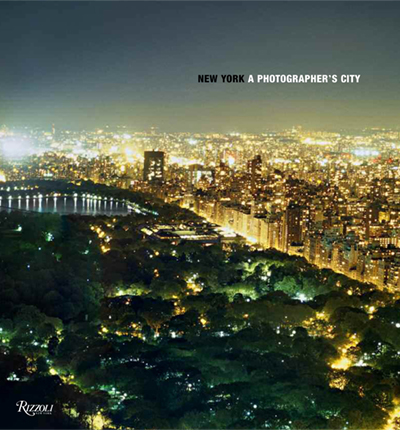

New York has always been a photographer’s city. The dynamic skyscrapers, the green spaces, the vibrant hustle of immigrant communities thrown together, has inspired a wide variety of photographers over the centuries. Some have been interested in the city as a focal point for social unease (Jacob Riis, Eugene Richards); others have been more concerned with capturing its beauty (Alfred Stieglitz, Berenice Abbott).
Visit any bookstore in the city, and you’re likely to find more than a few photography books on New York. There are books on specific subcultures, like Full Bleed: New York City Skateboard Photography, and beautiful historical survey photography books, like Reuel Golden’s New York: Portrait of a City. Until now, though, there hasn’t been a significant anthology of contemporary art photographers’ views of the city. That omission is addressed in New York A Photographer’s City (Rizzoli), a hefty coffee table book that features work by over 100 photographers.
(more…)
Click for slideshow From Polka Dots series 1976 Courtesy Betty & George Woodman

Photographer Diane Arbus once said that a photograph is “a secret about a secret. The more it tells you, the less you know.” Those words resonate powerfully in the work of Francesca Woodman, whose photographs from the 1970s and 80s are simultaneously mysterious, frank, playful, surreal, delicate and raw.
The daughter of two successful and accomplished artists, Woodman reached artistic maturity at an extremely young age. At thirteen, she was already making striking self-portraits; by the time she was seventeen, she was shooting haunting, intense images that were uniquely hers. Abandoned houses were her favorite place to work, but she also shot in forests and on beaches, where she placed female figures (often herself) communing with the environment in original, provocative ways. Sometimes, a surreal element creeps in: masks and mirrors hide faces, bodies are obscured by birch bark and peeling wallpaper. Woodman’s frank sexuality and daring enhances her perfectly-balanced compositions. Each image becomes its own little mystery.
Unfortunately, Woodman’s early work turned out to be her only work. In 1981, aged twenty-two and suffering from depression, she jumped to her death from a window in Greenwich Village. Like Diane Arbus, who also committed suicide, Woodman has become something of a mythic figure: the tortured girl genius whose talent couldn’t save her.
(more…)
Click for Slideshow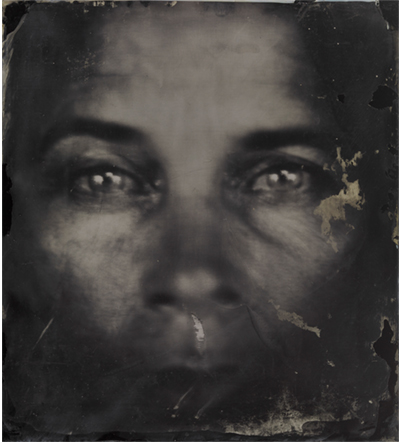

Sally Mann’s photographs have always had a tendency to unsettle people. Most famously, the photographer became a target of the culture wars in the early 1990s, when her direct, unsentimental images of her young children attracted national attention. Right-wing politicians were enraged that Mann, an artist supported by the National Endowment for the Arts, was photographing her children naked with bloody noses and urine-stained sheets. Unwittingly, she opened up a heated and vexing discussion about depictions of children in photography—a subject nuanced enough that it has inspired two novels to date: Kathryn Harrison’s Exposure and Dani Shapiro’s Black and White.
To Mann’s credit, there was no artistic compromise following her spell as a congressional punching bag. In the two decades since, she’s gone on to produce work every bit as challenging as her early images of her children. Now, The Flesh and the Spirit (Aperture), which accompanies a retrospective exhibition at the Virginia Museum of Fine Arts, gathers together nine series of her images. It confirms Mann’s position as a major American artist whose work is often beautiful, often disquieting, and sometimes both at once.
As the title implies, the images show an intense preoccupation with the human body and the relationship between its corporeal form and its animating life force.
(more…)
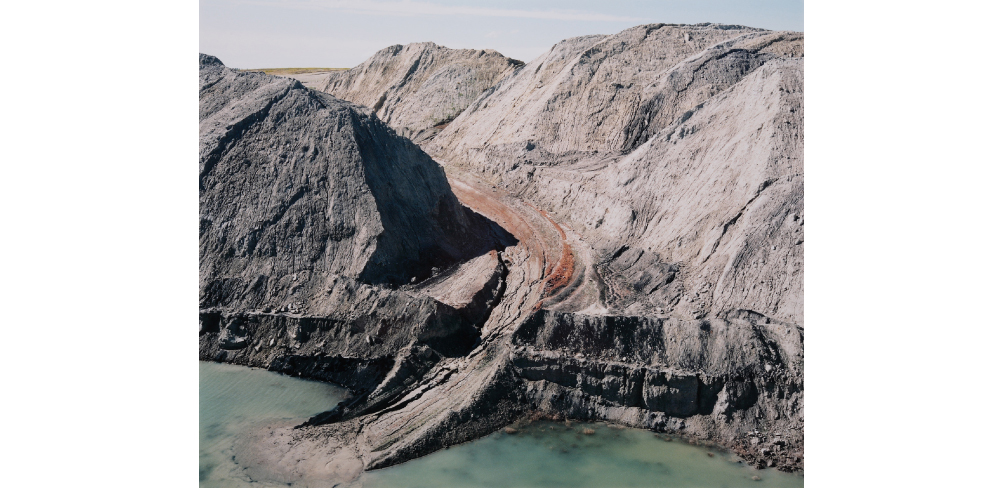
Mine spoil piles and intersected water table, 1984 (Click to enlarge)

Last April, the Deepwater Horizon tragedy showed us how crude oil can devastate an environment. But it’s not just explosions or spills that have hazardous effects on our fragile ecosystem. Sometimes, damage can be continuous and insidious—like it is at Colstrip, an enormous coal mine in southeastern Montana. Colstrip has the distinction of being one of the nation’s dirtiest, most polluting plants: each hour, it belches more than 400 pounds of sulfuric acid into the air, and its waste also filters down to the local water table, spreading toxins far and wide.
How do you convey this kind of unremitting, non-sensational damage? David T. Hanson took up the challenge, spending three years documenting the Colstrip plant and its surrounding town. His beautiful, melancholy images, which are now published in Colstrip, Montana (D.A.P.), were actually shot in the 1980s, but given our growing concerns about skyrocketing energy costs, peak oil, and environmental decay, they seem even more timely now.
The images are unsettling for several reasons. Hanson has a keen eye for color and composition, and there’s a classical beauty to most of the photographs. Shot from above, even deep gashes in the landscape and irridescent green waste ponds can look attractive, like a Rothko or Diebenkorn canvas. Even in devastation, there is beauty: anyone who doubts that need only look at Joel Meyerowitz’s photographs of Ground Zero or Robert Polidori’s studies of empty rooms after Katrina.
(more…)

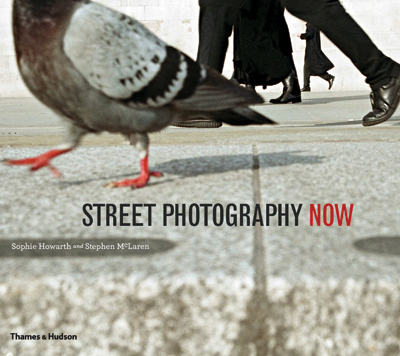
Trafalgar Square, London, 2007. © Matt Stuart. Images courtesy of Thames & Hudson

Street photography goes back at least to the 1930s, when Henri Cartier-Bresson roamed the streets of Paris with his lightweight Leica in hand. But it really came of age in the 1950s, when photographers like Garry Winogrand, Lee Friedlander, and Joel Meyerowitz made a point of spending all day on the streets, catching quirky, serendipitous moments of everyday life. The challenge, always, was to be in the right place at the right time, alert and perfectly positioned to capture what Cartier-Bresson called “the decisive moment” — when background, subject, and mood came together in surprising and revealing ways
In Street Photography Now (Thames & Hudson), authors Sophie Haworth and Stephen McLaren have put together a survey of some of the world’s best street photography at this particular moment. That’s no easy task, of course. The advent of sites like Facebook, Flickr, and Twitpic has made almost all of us into street photographers of one sort or another. To narrow down the task, Haworth and McLaren sought out “the strongest work by the most committed practitioners”, choosing forty-six photographers to represent the genre. Included are are some long-established names — such as Meyerowitz, who’s still going strong fifty years after his debut — but most of the photographers are up-and-coming, in their late thirties and early forties. In other words, they’re old enough to have developed a signature style, but young and energetic enough to pound the pavement every day.
(more…)
Dignity, cover. Photography by Dana Gluckstein. Click for Slideshow 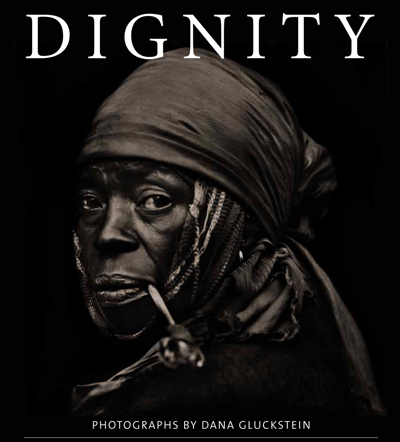

When Dana Gluckstein made her first trip to photograph indigenous Haitians in the 1980s, she didn’t know she was embarking on a three-decade-long journey. Led by instinct, Gluckstein — then a young photographer shooting for advertising campaigns and annual reports — simply wanted to do some work that felt more profound and personal. “I always knew I wanted to go deep, rather than stay on the surface,” she says. “I knew this was important work.”
In the twenty-five years since, Gluckstein has indeed gone deep. She’s traveled far, both in terms of air miles and insight into the human condition. Her quest to document indigenous peoples — many of whose cultures are threatened — has resulted in the stunning book Dignity (powerHouse Books, $39.95), published this month to coincide with the 50th anniversary of Amnesty International.
As Gluckstein is quick to point out, Dignity is more than just a beautiful coffee table book. It’s also a passionate call to action. While indigenous peoples comprise six percent of the global population and are among its most impoverished and oppressed inhabitants, they remain largely invisible and it’s easy to ignore their plight.
Shot in black and white on a vintage Hasselblad, Gluckstein’s images show us the beauty, strength, and vivacity of these “first peoples”. Often intimate, sometimes breathtaking, the photographs in Dignity have a classical feel and a rich, velvety softness. Gluckstein’s artistry is matched by her deep compassion for her subject matter — a compassion that has sustained her through a quarter century of work.
(more…)
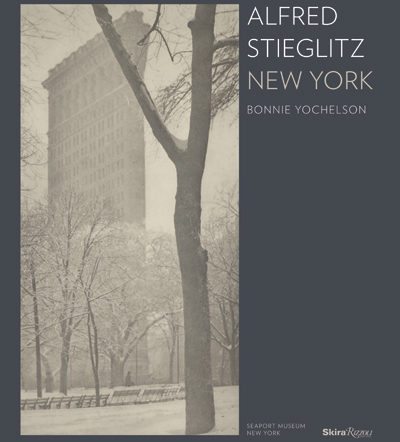
All photography by Alfred Stieglitz. Courtesy of National Gallery of Art and Skira/Rizzoli.

The word “ambitious” barely covers the life and work of Alfred Stieglitz. He was a photographer, a gallery owner, a magazine editor, and probably the man most responsible for bringing photography to the art world. Along the way, he also found time to marry a young Georgia O’Keefe and seal her reputation as a painter.
As a photographer, Stieglitz experimented with many subjects, from New York street scenes to cloudscapes to sultry portraits of O’Keefe. Behind all of his images was the driving philosophy of “pictorialism”, a belief that photographs should look like paintings. His most celebrated image is The Steerage, a picture of poor immigrants on a steamship. Where another photographer might have focused on faces and gestures, Stieglitz makes it a Cubist-like study of form and light.
New York, and its teeming street life, was a subject Stieglitz returned to throughout his career. In Alfred Stieglitz New York, the city is shown over a period of five decades, but always filtered through Stieglitz’s unique personality. Beauty and desolation are given equal weight. As Georgia O’Keefe once said of her husband, it was as though “something hot, dark, and destructive was hitched to the highest, brightest star”.
(more…)

 Think of everything you know about global warming. Think, especially, of the sense you might have that there are twenty, thirty, fifty years left before the Earth’s levels of climate change become truly catastrophic. Now, think again. We’re already there, says Bill McKibben in Eaarth (Times Books, $24.00), an eloquent and passionate call to action. In fact, says McKibben, we’ve changed our planet so much that we can no longer think of it as Earth: now it’s Eaarth, a place of melting ice caps, expanding tropics, and increasingly dramatic “weather events”. And we have to learn to live there.
McKibben should know what he’s talking about. A leading journalist and environmental activist, he’s been writing on this subject for more than twenty years. In 1989, his The End of Nature was the first book on global warming for a general audience. In the past two years, his nonprofit 350.org has mobilized millions of people across the world to combat climate change.
In Eaarth, he makes no bones about how serious the situation has become. We’ve already raised the temperature of the planet by one degree Celcius, he writes; as a result, the Arctic ice cap is 1.1 million square miles smaller, and (since warmer air holds more water vapor) global rainfall is increasing by 1.5 percent a decade. But this isn’t just a book full of dry statistics. McKibben is expert at explaining, lucidly and frankly, just what the numbers mean, and what we can do about them. “Forget the grandkids,” he writes. “It turns out this was a problem for our parents.”
(more…)


