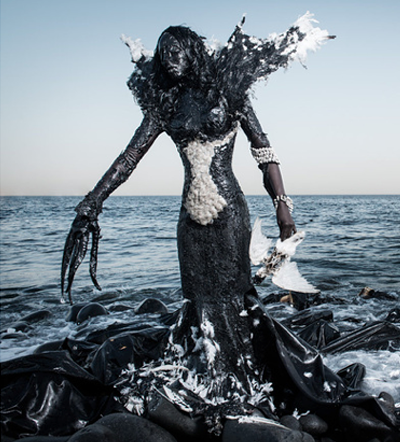
© Fabrice Monteiro

Jinn are described as the “supernatural genies omnipresent in African cultures”. Fabrice Monteiro has been working with Ecofund in Senegal, West Africa, to create images that weave together interpretations of these supernatural beings and very real scenes of Senegal’s environmental destruction. Detailed costume and lighting design are used to turn locations representative of ecological damage into images of foreboding, and Monteiro’s decision to give these harsh scenes human faces means we can more easily interpret the pain, anguish, demise and, hopefully, strength. When we scrutinize the immensely detailed images, the alien landscapes are exposed as foreign realities that offer powerful insight into our own future if we do not alter our current trajectory.
Prophecy has been created to distribute as an educational art book through the Schools of Senegal.
Slideshow
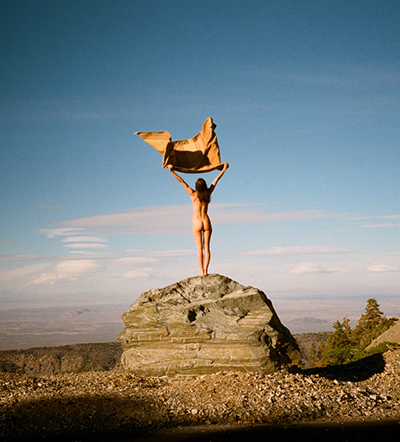

Magdalena Wosinska has been a favorite at PLANET since we first introduced her in the spring of 2012. What we loved about her then is what we love about her now – an unabashed freedom and spontaneity in her life, and an inseparable link between her life and her art. She best summed it up in her very first interview with us: “I love what I shoot, it’s my real life, it’s my breath. I couldn’t ask for anything more.”
Three years later, and Magdalena has continued to live free and document, rising in the photography and art world on the same breeze she entered with. Her new book, The Experience Vol. 1, presents the latest installment of her journey with a lens. One series that has taken shape over the last few years has been self-portraits she’s been taking of herself in various locations from her travels, with her back to the camera and almost always nude. What began as a simple and clever way to get around Instragram censorship, took on a life of it’s own and has developed into a unique, and ongoing, self-portrait series. We’re pleased to present a slideshow of this series below, as well as a brief interview about it with Magdalena.
Slideshow
(more…)

Although the following music video is about a year old, we wanted to present it in this format because it’s an exceptional work, even sublime in its innovative simplicity. Created by experimental visual creators Romain Assenat and Ana Silva for Nils Frahm’s composition, Says, which itself is a masterpiece of contemporary musical exploration, the video applies a method of video feedback to create a unique visual experience of beats and musical punctuation. In our age of digital manipulation of everything, it’s remarkable to learn that this was created in a largely analog process, in a single take, which Romain and Ana share with PLANET in the following interview.
For starters, can you tell us a bit about yourselves, where you live, what you do, and how you came to direct the Nils Frahm video for Says?
Ana:
We are a French-Portuguese couple living in Brussels for several years, and we love experimental music and arts. I work in the social field with young people and Romain has made me discover the experimental music world and, more specifically, Nils’ work in 2010.
Watch the video here.
(more…)

Evan Tetreault

Evan Tetreault uses film photography to create his own visual diary, a photographic record of personal memories. This collection documents recent travels through New Zealand and the North East Coast of America, far from his newly adopted Los Angeles home. The mix of portrait and landscape images creates a unique world of intimate moments that invites us to view and appreciate life’s subtleties, but it is a world we can never fully penetrate. The landscapes are wide and dreamlike, portraits are tightly cropped and the surroundings are askew; often, turned heads avoid the audience’s gaze and allow us to look longer and create our own narratives.
Evan has discussed the importance of film photography, and its value as a medium that encourages the artist to make a photo rather than simply take a photo. This approach to the medium also invites the audience to stop and take note of a moment and an image, instead of skipping so quickly onto the next.
Slideshow
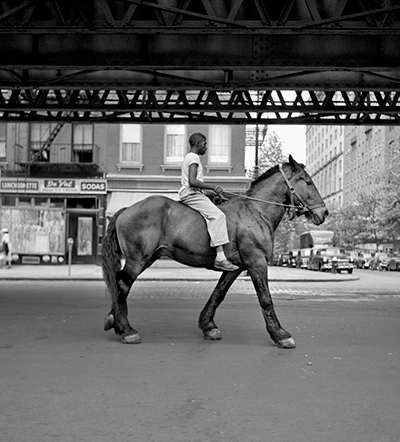

Vivian Maier’s photography has had a seismic effect on the art world since it was discovered a few years ago. The poignant story behind the work enhances its appeal: Maier was one of the finest street photographers of the mid-twentieth century, yet she kept her work hidden and died in poverty. In fact, she worked as a nanny for her entire career, living with a succession of suburban families and becoming increasingly eccentric. Her employers knew her as a shutterbug, but it was only after her death that the amazing quality and breadth of her work was discovered.
Maier’s photography, and her fascinating story, would never have come to light if not for John Maloof, a young Chicagoan who happened across a trunk of her negatives at a local auction house. In the absorbing new documentary Finding Vivian Maier, Maloof traces the story of his find, and the obsessive quest he went on to solve the mystery behind the treasure trove of images Maier left behind.
The film, which is both unsettling and delightful, offers a compelling, bittersweet portrait of a very complicated woman. A veritable Mary Poppins figure to some of the children she worked with, Maier was abusive to others. She was extremely wary of men, in a way that suggested she might have been abused herself. Often she refused to give her name and occupation to people, referring to herself as “the mystery woman” or “a kind of spy.”
(more…)
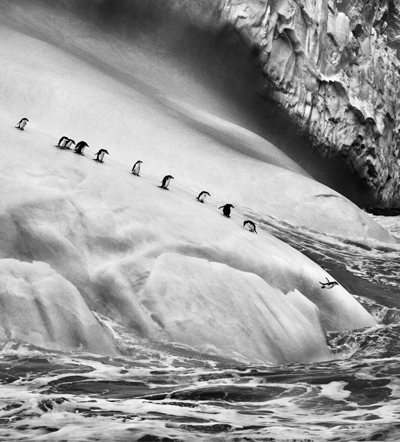
click for slideshow

“Photography invaded my life,” Sebastião Salgado says during a TED speech on
Genesis. An activist and former economist, Salgado’s demeanor is telling of the forty years he’s dedicated to capturing and witnessing the world’s most devastating tragedies. In 1994, Salgado was in Rwanda, documenting the genocide of the Tutsi, which would later be published in
Migrations (2000). It was this that led Salgado to crave a project where his focus was not the tragedy of humanity, but instead, the beauty of this planet. The result is
Genesis, his most recent and, he says, final project as a photographer.
Published by Taschen, Genesis is the result of approximately thirty trips on foot, light aircraft, boats, canoes, and hot air balloons over almost a decade. Some may view Genesis as a tangent to Salgado’s previous work, however, Salgado states that his mission has not varied and is instead simply approaching the same message from the opposite end.
It is a remarkably positive statement for a photographer who has spent his life following devastation. Biblical landscapes and portraits of those unadulterated by modern society span a mammoth 520 pages, voicing the beauty that still exists on our planet. According to Salgado, “Forty-six percent of the planet is still as it was in the time of genesis”.
(more…)
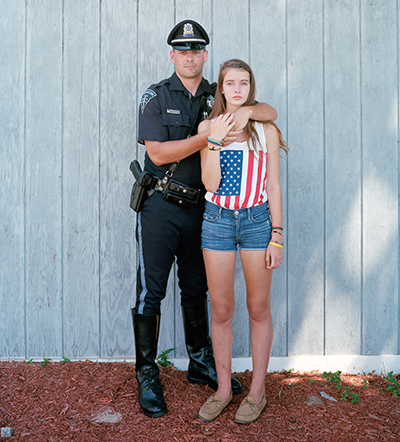
Nathan and Robyn, 2012, Provincetown, MA

PLANET previously introduced
Bus Travelers by Richard Renaldi, a series of work that encapsulates Renaldi’s fascination with people and their idiosyncrasies. Taking this fascination further, Renaldi has been working on a project since 2007 that explores what would happen if two complete strangers were asked to physically interact with each other for a portrait. Taking the subjects out of their comfort zone, the strangers would stand intimately, while Renaldi disappeared behind an 8 x 10 large format camera. Thus began,
Touching Strangers, Renaldi’s newest body of work.
Photography is often seen as a one man show but in Renaldi’s case, this is hardly true. The series is yet to be finished however, and relies on backers like yourself to publish the book via the Aperture Foundation. From now till August 5th, 2013, Touching Strangers can be pre-ordered on Kickstarter, which is scheduled to be released spring of 2014.
Those who support the campaign, will receive a special Kickstarter edition of the book, bound in cloth with special design and production features separate from those that will be distributed in stores. Signed and edition prints of his work are also available.
Slideshow
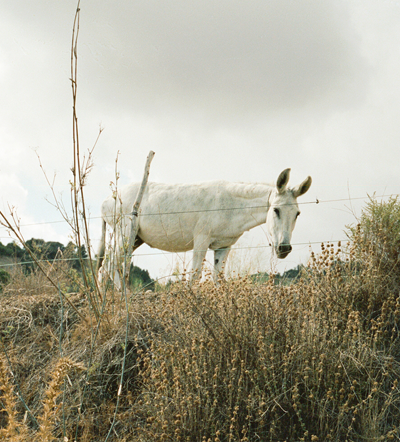
© Roberta Ridolfi

Like memories suddenly resurfacing, Italian photographer Roberta Ridolfi shares rediscovered images from a trip to Andalusia last September. “It’s amazing how editing can change the meaning of an edit,” she says. The edit indeed has a lighter mood compared to the original. Ridolfi finds inspiration from classic cinema, as if foretelling of her chosen title for the original series,
Texas Hollywood. As if to emphasize this natural psyche, the way she describes how she became a photographer, is like reading the opening of a story: “My uncle had an old Nikon he bought in the 70’s he hardly ever used. For some reason he thought I could do something with it. Next thing I knew, I quit university and enrolled myself in a photography course. One thing led to another.”
Roberta currently lives and works in London as a fashion photographer.
Slideshow
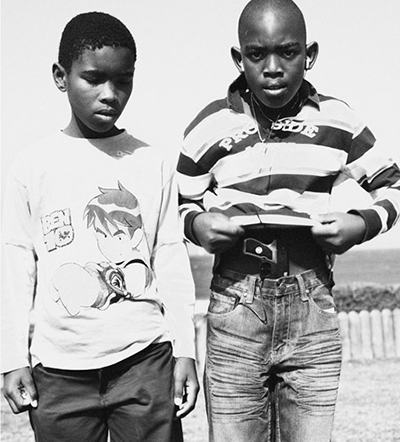
© Misha Taylor

Most may be familiar with Misha Taylor as a fashion and portrait photographer whose undeniably seductive and grappling work has graced the pages of magazines such as
V Man. In a rare instance, today, Taylor shares with PLANET a very special personal project he has been working on.
Taken in Durban, South Africa, these images reveal a reality that often goes unrecognized in mainstream media– the effects of Chinese trade agreements on the youth of Africa. Ice cream vendors on the beach fronts of Durban sell 9mm replica pistols that shoot plastic BB guns made in China to young children. Regulations in China forbid the sale of such items within its own country’s borders, subsequently forcing exports to countries like Durban, where a less controlled government sees them sold, not only without regulation, but to those as young as six years old. On the one hand, Misha tells PLANET, “what is happening isn’t all bad”– indeed, Africa needs investment that can boost education and development and China needs Africa’s natural resources. However the emerging economic and political power of China on Africa has been a dual dance of good and bad.
Slideshow
(more…)
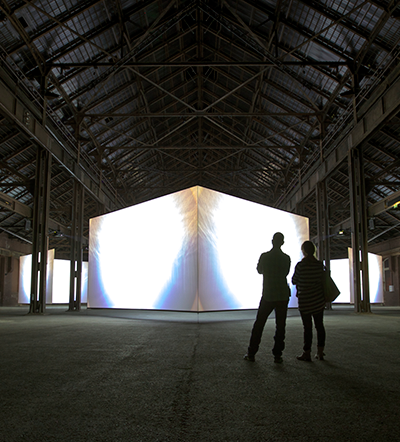
Doug Aitken, Altered Earth, 2012. Commissioned and produced by the LUMA foundation, photo © Robert Leslie.

The gallery walls came tumbling down in the 60’s and 70’s when a generation of land artists stepped outdoors and used nature as their canvas. For Robert Smithson, the doyen of the Earthworks movement, whose “Spiral Jetty” still protrudes from the shore of the Great Salt Lake, art was meant to engage with the outside world in a way that it couldn’t when cooped up inside. “A work of art when placed in a gallery loses its charge,” he stated in that earlier era.
It’s a shame Smithson couldn’t be there for Doug Aitken’s projection of movie images on the façade of New York’s MoMA for 2007’s “Sleepwalkers.” It was a case of art finding its way outside the museum’s walls but with the added twist of actually becoming the museum’s walls. Delineations between inside and out, real world and representation, never felt so fluid.
As a multimedia innovator, Aitken has built a reputation for reimagining time and space. Few artists come better equipped to capture the kaleidoscopic fever dream we know as life in the present day. With his latest installation, “Altered Earth,” he sets about creating what’s being billed as land art for the electronic age, and in 21st Century fashion, the results are disorienting and overwhelming.
(more…)



 Facebook
 Permalink
 Digg
Digg Reddit
 LinkedIn
 StumbleUpon
 Tumblr

