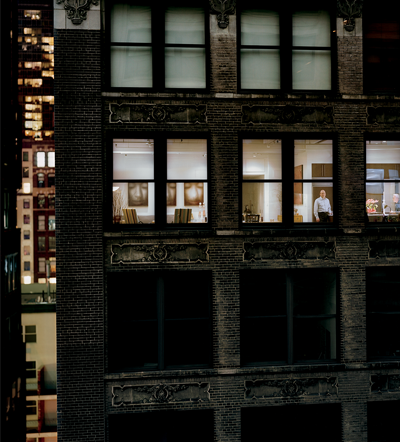
From Out My Window by Gail Albert Halaban, published by powerHouse Books

If you live in a city, in a place where you can look into other people’s windows through your own, it may be irresistible to indulge your voyeuristic impulses. We all love mysteries, and what could be more mysterious than a parallel life witnessed in glimpses through glass? Just ask Jeff Jeffries, the character played by James Stewart in Hitchcock’s masterful
Rear Window. Laid up at home with a broken leg, Jeffries gets so involved with his Greenwich Village neighbors that he gives them inventive nicknames like “Miss Torso.”
With its crowded-together buildings and social diversity, New York City is the perfect locus for a film like Rear Window, or the similarly voyeuristic Dirty Windows, photographer Merry Alpern’s 1995 book of images secretly shot through the window of a low-rent sex club. But not everything going on through those neighboring windows is tacky or suspicious. Witness Gail Albert Halaban’s beautiful new book Out My Window (powerHouse), a warm and lyrical study of New Yorkers and their windowscapes.
Slideshow
(more…)
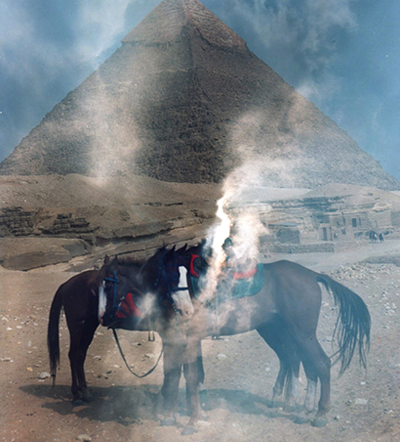
© Ariko Inaoka

Ariko Inaoka is a photographer from Kyoto, who only shoots film to this day and has her own color dark room. PLANET is pleased to present Ariko Inaoka’s beautiful world full of light and wonder.
Slideshow
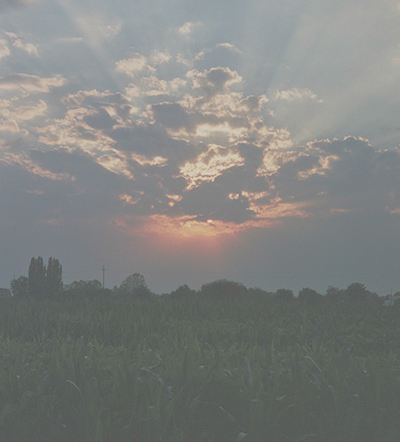
© Samantha Casolari

When photographer and past PLANET contributor Samantha Casolari told us she was headed home to Italy for summer vacation, we asked if she could send back some images from her trip. The collection presented here, intimate images that exude a sense of place, friendship, and the passage of time, are imbued with Samantha’s signature sense of color and mood. They are fitting remembrance of a summer just passed.
Slideshow
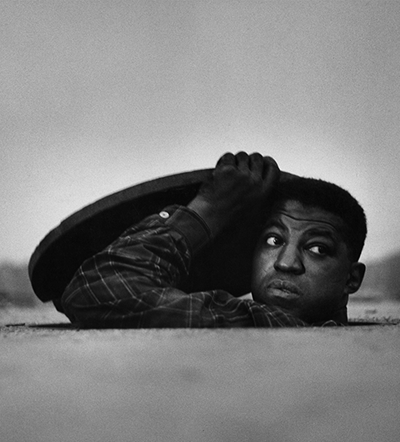
The Invisible Man, Harlem, New York, 1952. Gelatin silver print

“I am an invisible man,” begins Ralph Ellison’s famous 1952 novel, in an opening that rivals “Call me Ishmael” and “Lolita, light of my life” for its compact resonance. The narrator of
Invisible Man goes on to say that he’s “not a spook like those that haunted Edgar Allan Poe; nor am I one of your Hollywood movie ectoplasms.” Instead, his invisibility is caused by race: being a black man in 1950s America makes him a blank canvas onto which people’s fears and anxieties are projected.
How do you photograph an invisible man? That was the challenge Gordon Parks took up in 1952, when Invisible Man was published. At that time, Parks himself was a highly visible black man. He’d broken through race barriers to become the first African-American staff photographer at Life magazine, and had written his own prose and poetry. He’d made an enduring and iconic portrait, American Gothic, in which a dignified cleaning woman symbolizes the shabby treatment of blacks in America.
The soulful images Parks produced, with inspiration from Ellison’s novel, are the subject of an intriguing exhibition, Contact: Gordon Parks, Ralph Ellison and ‘Invisible Man’ at the Howard Greenberg Gallery. At the time he made this work, Parks had just won a plum assignment to work in Paris for Life. He was leading a cosmopolitan life of glamor–but his passion and empathy for Harlem shines bright and clear in his Invisible Man series.
(more…)
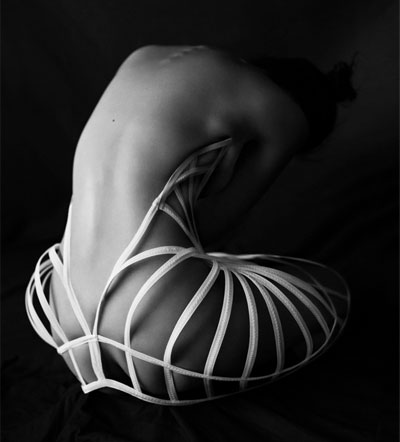

Fashion photographer Billy Kidd’s newest work explores his partner and muse, Heather Huey, a milliner whose pieces have caught the attention of stylists such as Karl Templer and Nicola Formichetti. Huey and Kidd have been working together as artists and lovers with Billy behind the lens and Heather as inspiration for almost two years, using Huey’s body cages and sinuous cocoons to help create poetic images that retain intimacy and anonymity. The result is an erotic ballad that is contemporary yet classic. Their work will be on view from September 6th at Clic Gallery.
Both of your work have an aesthetic that is undeniably grounded in classical aesthetics–Billy your work recalls Lee Miller and Man Ray, Heather you create headpieces, which are historically significant. Yet both of your work is undeniably contemporary. Has this brought you together?
Billy: I feel that’s why Heather and I get along so well. We have such similar tastes that we often respond to the same things.
How did this body of work begin?
Billy: We started shooting almost 2 years ago as a photographer often does with his lover/muse. Heather being the shy one, took some time to open up in front of the camera. Our love and comfort with each other was the catalyst for where it went. It was a goal of mine to, without retouching, to alter her body into different shapes.
Slideshow
(more…)
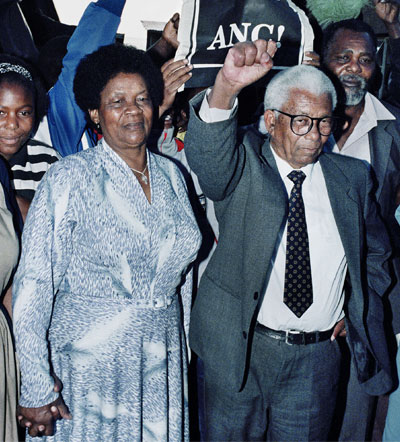
Greame Williams, Sisulu released. South Africa, Soweto, 1989. © Greame Williams.

ICP’s latest tour-de-force historical exhibition is
Rise and Fall of Apartheid: Photography and the Bureaucracy of Everyday Life, opening September 14th. The exhibit attempts to include all the important forms of visual documentation that bore witness to South Africa’s sixty years of apartheid: films, books, and photographs in all forms, from newspaper-commissioned to social documentary to photo essay.
The exhibition is of course powerful for its subject matter, and the show digs deep in its illustration of how apartheid touched every aspect of life, large and small. You see the South African Communist Party demonstrating in a large group, with arms raised defiantly and film cameras swarming the scene. Contrast this with the lone woman on a streetcorner, protesting against hangings to passing traffic. Contrast this with a pro- segregation demonstration backed with Biblical quotes. Throughout, Rise and Fall of Apartheid is valuable for the way it showcases South African photographers working in incredible times, and under incredible pressures.
The show’s deep reach is thanks to its curators, the Nigerian-born Okwui Enwezor with Johannesburg-based Rory Bester, two specialists of modern and recent-era South Africa. Rise and Fall of Apartheid runs September 14 – January 6.
Slideshow
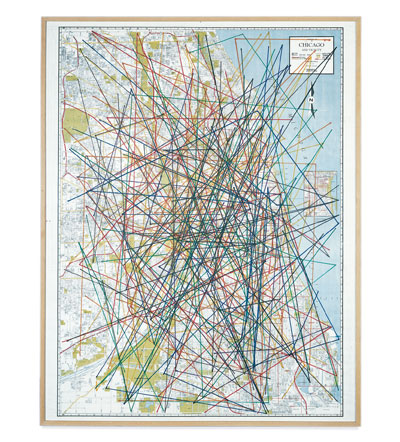
John Cage, A Dip in the Lake, 1978.

John Cage has been an important figure on the landscape of the Museum of Contemporary Art Chicago since literally the beginning: he performed at the opening of the institution’s first-ever exhibition in 1967. In the decades that followed, Cage and the MCA enjoyed a fruitful working relationship, with the artist creating and performing scores on-site and the museum hosting performances of his works over the decades, continuing after his death in 1992 and into the present day.
If only just for those performances, MCA would be a precious keeper of Cage’s legacy. But the museum has more: the material results of its long association with the artist can be seen in MCA DNA: John Cage, a multimedia exhibition opening September 1st of photographs, letters, performance, video, and Cage’s idiosyncratic scores, the most famous of which is created on a large map of Chicago. The exhibit seeks to make Cage’s scores come alive again, with displays and materials that demonstrate how to interpret them. Elsewhere the artist’s influences, such as books he kept, sit next to notes he wrote and archival papers documenting his time at MCA. The exhibit mixes art with archive and creative with strictly professional, and keeps the close link to the MCA as a central element throughout. As site-specific as a Cage performance and equally unpredictable, MCA DNA: John Cage is a snapshot of an extraordinary artist’s process.
Slideshow
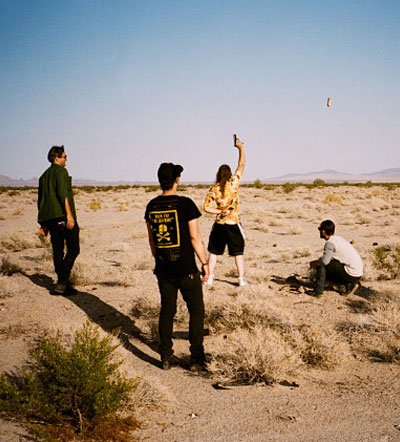
© Magdalena Wosinska

In May PLANET introduced photographer Magdalena Wosinska and her soon-to-be-released book,
This Grass is Electric. At the time she had just returned from a road trip with friends that involved shotguns, cliff-jumping in the nude, and exploring natural psychedelic substances as they rode motorcycles from Los Angeles to Laughlin, Nevada for a Harley Davidson convention. PLANET is pleased to present images from this “typical weekend with these kids,” as Wosinska describes it.
Slideshow
Courtesy of Peter Hay Halpert Fine Art

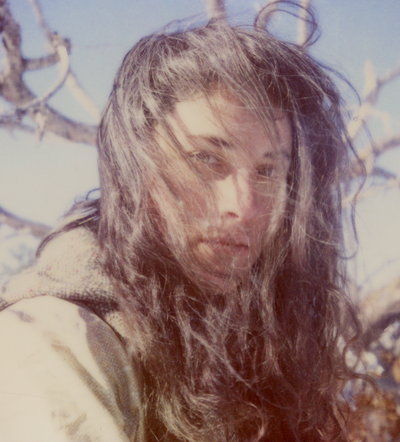
In 1999 Mikael Kennedy, then a 20-year-old college student, took his first cross-country trip with his thrift store-bought Polaroid camera in tow. This “exhilarating and at times terrifying” experience of living out of his car and “documenting anything and everything” via Polaroid would become both his way of life for the next 12 years and the subject of his epic series
Passport to Trespass. In Kennedy’s Polaroids you see a young nomad exploring lush evergreen forests, dirt roads, cityscapes under the murky moonlight, deserts, and oceans. You also see his friends: bright-eyed and bold 20 somethings, living rough yet seemingly immersed in their present. In 2005, having accrued more than 1000 images, Kennedy created the acclaimed website to which he uploaded groups of photos arranged in chronological order. Their laconic titles and lack of description leaves context and meaning up to the viewer. The medium, however, of Polaroid film fosters intimacy— one sees Kennedy’s life as an open book.
Kennedy’s recent show at Clic gallery in New York titled
Between Dog and Wolf culminated his series with a look at the tension between two worlds he’s come to know quite well: domestic and wild. PLANET spoke to Mikael Kennedy about his current state of transition.
Slideshow
(more…)
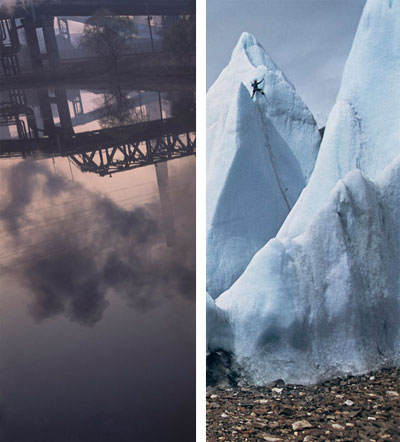
Niu Guozheng, Pingdingshan, China (left) Jimmy Chin, Rongbuk Glacier, Tibet (right)
 Some say the world will end in fire, some say in ice.
 That morbid line belongs to an American poet with a last name in keeping with the latter category. And while Robert Frost wasn’t thinking about climate change when he wrote those words, the evidence provided by scientists — not to mention the disaster-filled evening news telecasts of recent weeks — suggests that he might have been on to something. We won’t get ahead of ourselves with thoughts of the end of the world, but as the planet continues to warm, it would appear that fire’s supremacy over ice is gaining momentum in much of the country.
It was in the same overarching context that a prominent exhibit in documentary photography opened in Beijing last year, titled “COAL+ICE.” Organized by the Asia Society’s Center on U.S.-China Relations, the installation was split between depictions of China’s coal mining industry and the melting glaciers in the country’s Tibetan Plateau with the clear implication that the two subjects share a crucial link. Now that a condensed version is being shown at the Resnick Gallery in Aspen, CO through the end of the month, it’s worth taking a look at this ambitious collection of works and at the calculus under which coal fire plus Himalayan ice equals something none of us want to see.
(more…)



 Facebook
 Permalink
 Digg
Digg Reddit
 LinkedIn
 StumbleUpon
 Tumblr


